Understanding Your Pool System: Pump, Filter, and Plumbing
If you just became a pool owner — congratulations! Whether you bought a home with a pool in Jacksonville, St. Johns County, or anywhere in Northeast Florida, you're about to enjoy one of the best perks of living in the Sunshine State. But before you cannonball in, it helps to understand how your pool actually works. Pool maintenance for beginners starts with knowing the basics of your equipment, and once you get the hang of it, taking care of your pool becomes second nature.
Think of your pool as a living system with three core components that work together to keep your water clean and safe.
The Pool Pump
The pump is the heart of your pool. It pulls water from the pool through the skimmer and main drain, pushes it through the filter, and returns it back through the return jets. Without the pump running, your water would become stagnant within days — and in Jacksonville's warm climate, stagnant water is an open invitation for algae and bacteria.
Most residential pools in our area use either a single-speed pump or a variable-speed pump. If your home came with an older single-speed model, it runs at one constant speed and typically costs $80 to $150 per month in electricity. Variable-speed pumps, which are now required by Florida law for most new installations and replacements, let you run at lower speeds for daily circulation and ramp up only when needed. They typically cut energy costs by 50 to 70 percent — saving you $50 to $100 per month on your JEA bill.
Your pump should run 8 to 12 hours per day during Jacksonville's warmer months (roughly March through October) and 6 to 8 hours during the cooler season. This ensures all the water in your pool passes through the filter at least once per day, which is called a complete "turnover."
The Pool Filter
The filter is where the actual cleaning happens. As water passes through, the filter media traps dirt, debris, and microscopic particles. There are three common types you might find on your equipment pad:
- Cartridge filters: Use a pleated fabric cartridge to trap debris. Easy to maintain — you just pull out the cartridge and hose it off every few months. Popular in newer Jacksonville homes. Brands like Pentair Clean & Clear and Jandy CL are common.
- Sand filters: Water passes through a bed of special filter sand that traps particles. Cleaned by "backwashing," which reverses the water flow to flush out trapped debris. These are low-maintenance and reliable, lasting 5 to 7 years before the sand needs replacing.
- DE (diatomaceous earth) filters: The finest filtration available, capable of trapping particles as small as 3 to 5 microns. They use a powder made from fossilized organisms coated onto internal grids. Excellent water clarity but require more hands-on maintenance.
No matter which type you have, keep an eye on the pressure gauge mounted on top of the filter. Write down the "clean" pressure when everything is freshly maintained (usually 8 to 15 PSI). When the pressure rises 8 to 10 PSI above that baseline, it's time to clean the filter.
The Plumbing
Your pool's plumbing is the network of PVC pipes that connects everything — skimmers, main drains, return jets, equipment, and any water features. Most of it is buried underground or concealed in the equipment pad, so you won't interact with it directly. But knowing a few basics helps:
- Skimmers are the rectangular openings on the pool wall with a floating weir door. They pull surface water (and floating debris) into the filtration system.
- Return jets push filtered water back into the pool. Aim them in a circular pattern to promote good circulation and eliminate dead spots.
- Valves on the equipment pad control water flow between different lines. Your pool technician adjusts these as needed, but as a new pool owner, it's good to know where they are and what position they're normally in.
Water Chemistry Basics for New Pool Owners
Water chemistry is the part of pool care that intimidates most beginners, but it doesn't have to be complicated. At its core, you're managing a handful of numbers and keeping them within their ideal ranges. Think of it like checking the oil, tire pressure, and coolant in your car — a few quick checks that prevent big, expensive problems.
Here are the key parameters every new pool owner needs to understand:
Free Chlorine: 2-4 ppm
Chlorine is your pool's primary sanitizer. It kills bacteria, viruses, and algae. Below 2 parts per million (ppm), your pool is vulnerable to contamination. In Jacksonville's heat, chlorine gets consumed quickly, so you'll need to add it regularly — typically a gallon or two of liquid chlorine per week for an average-sized residential pool, more during peak summer.
A gallon of liquid chlorine costs about $4 to $6 at most hardware stores or pool supply shops in the Jacksonville area. Leslie's Pool Supplies, Pinch A Penny, and even Home Depot carry the essentials.
pH: 7.4-7.6
pH measures how acidic or basic your water is. This is the single most important number to watch because it affects everything — how well your chlorine works, how comfortable the water feels, and whether your pool surfaces are protected. Use muriatic acid to lower pH (about $8 per gallon) or soda ash to raise it.
Total Alkalinity: 80-120 ppm
Alkalinity acts as a buffer that keeps your pH stable. If alkalinity is too low, your pH will bounce around unpredictably. If too high, pH tends to drift upward and resist correction. Adjust with baking soda (sodium bicarbonate) to raise it or muriatic acid to lower it.
Cyanuric Acid (Stabilizer): 30-50 ppm
Stabilizer is like sunscreen for your chlorine. Without it, Jacksonville's intense UV rays will burn off your chlorine in just a couple of hours. With the right amount of stabilizer, your chlorine lasts much longer. But too much stabilizer (above 70-80 ppm) actually makes chlorine less effective, so don't overdo it.
How to Test Your Water
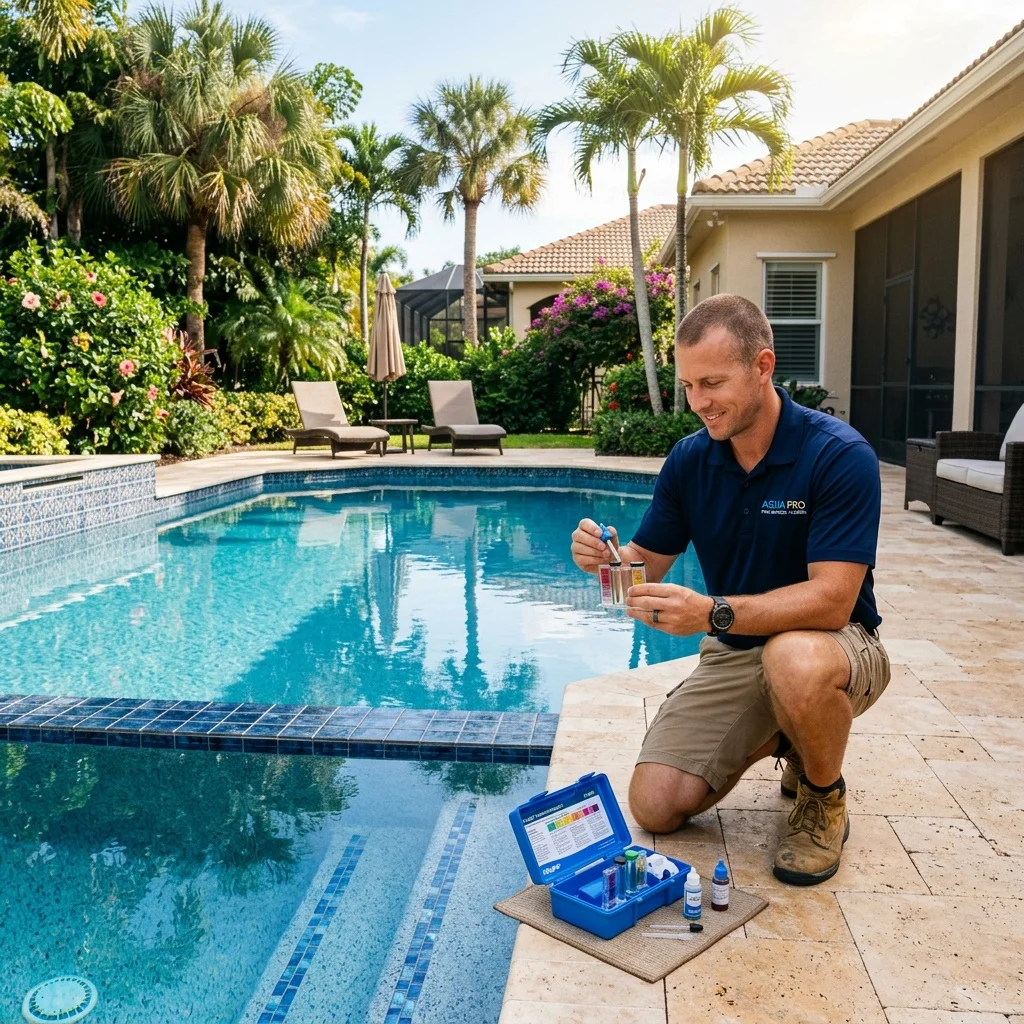
Pick up a basic test kit or test strips to get started. The Taylor K-2006 test kit (around $80) is the gold standard that pool professionals use, but for beginners, a set of 5-way or 7-way test strips ($10 to $15 for a bottle of 50) works fine for weekly monitoring. Dip a strip, compare the colors to the chart on the bottle, and you'll know where you stand in about 15 seconds.
Test your chlorine and pH at least twice per week during summer and once per week during the cooler months. Test alkalinity and stabilizer at least once per month.
Essential Pool Cleaning Equipment You Need
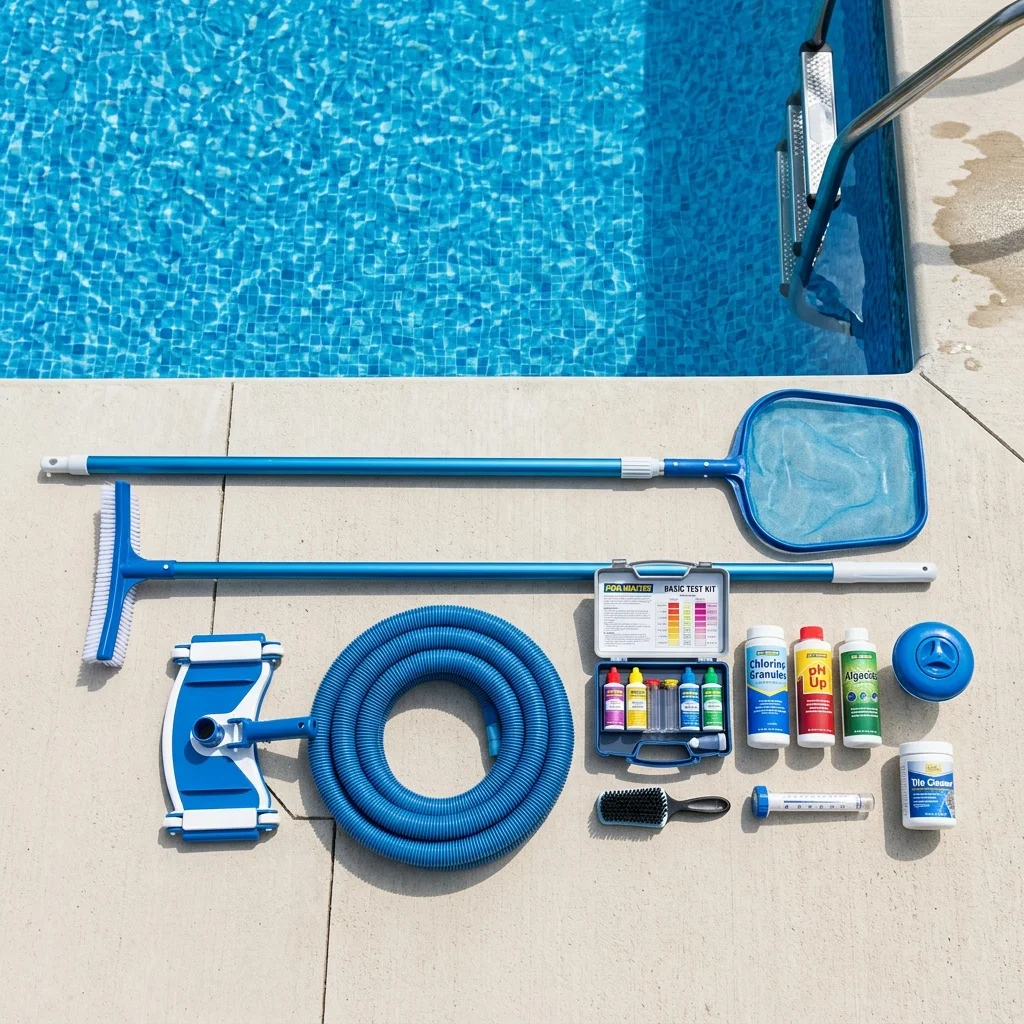
You don't need a garage full of fancy tools to keep your pool clean. Here's the essential equipment every new pool owner should have on hand:
The Basics (Under $100 Total)
- Telescoping pole: This is the universal handle that attaches to your skimmer net, brush, and vacuum head. Get an aluminum pole that extends to at least 12 feet — long enough to reach the center of most residential pools. Around $25 to $40.
- Leaf skimmer net: A flat or deep-bag net that attaches to the telescoping pole. Use it to scoop leaves, bugs, and debris off the surface and bottom. A good one costs $10 to $20.
- Pool brush: An 18-inch wall brush for scrubbing surfaces. Use a stainless steel bristle brush for plaster or concrete pools, and a nylon bristle brush for vinyl, fiberglass, or painted surfaces. About $15 to $25.
- Test kit or test strips: As mentioned above, $10 to $80 depending on which route you choose.
Nice to Have (Invest Over Time)
- Manual vacuum head and hose: Connects to your skimmer via a vacuum plate and lets you manually vacuum the pool floor. A vacuum head costs about $20 to $30 and a hose runs $25 to $50 depending on length. This is essential if you don't have an automatic cleaner.
- Robotic pool cleaner: The biggest quality-of-life upgrade you can make. A robotic cleaner like the Dolphin Nautilus CC Plus ($500 to $700) or Polaris VRX iQ+ ($800 to $1,200) runs independently of your pool's filtration system, scrubbing and vacuuming the floor, walls, and waterline on its own. Just drop it in, press a button, and pull it out when it's done. It's an investment, but many Jacksonville pool owners say it's the best pool purchase they ever made.
- Leaf canister/leaf trap: If your pool is near oak trees (common throughout St. Johns County), a leaf canister connects between your suction cleaner and the skimmer to catch large debris before it clogs the pump basket.
Chemicals to Keep on Hand
Stock your pool shed with these basics:
- Liquid chlorine (sodium hypochlorite) — buy in bulk during summer
- Muriatic acid — for lowering pH and alkalinity
- Sodium bicarbonate (baking soda) — for raising alkalinity
- Soda ash (sodium carbonate) — for raising pH
- Cyanuric acid (stabilizer) — you may only need this once or twice a year
- Granular shock (calcium hypochlorite) — for occasional shock treatments
- Algaecide — a good preventive backup, especially during the rainy season
Creating Your First Pool Maintenance Routine
Consistency is the secret to easy pool care. A new pool owner who sticks to a regular routine will spend far less time and money than someone who only reacts when problems appear. Here's a simple schedule that covers all the pool care basics.
Daily (2-3 Minutes)
- Glance at the pool: Look at the water clarity and color. Clear and blue means things are working. Hazy or green means something needs attention.
- Check the pump: Make sure it's running during its scheduled hours. Listen for unusual noises.
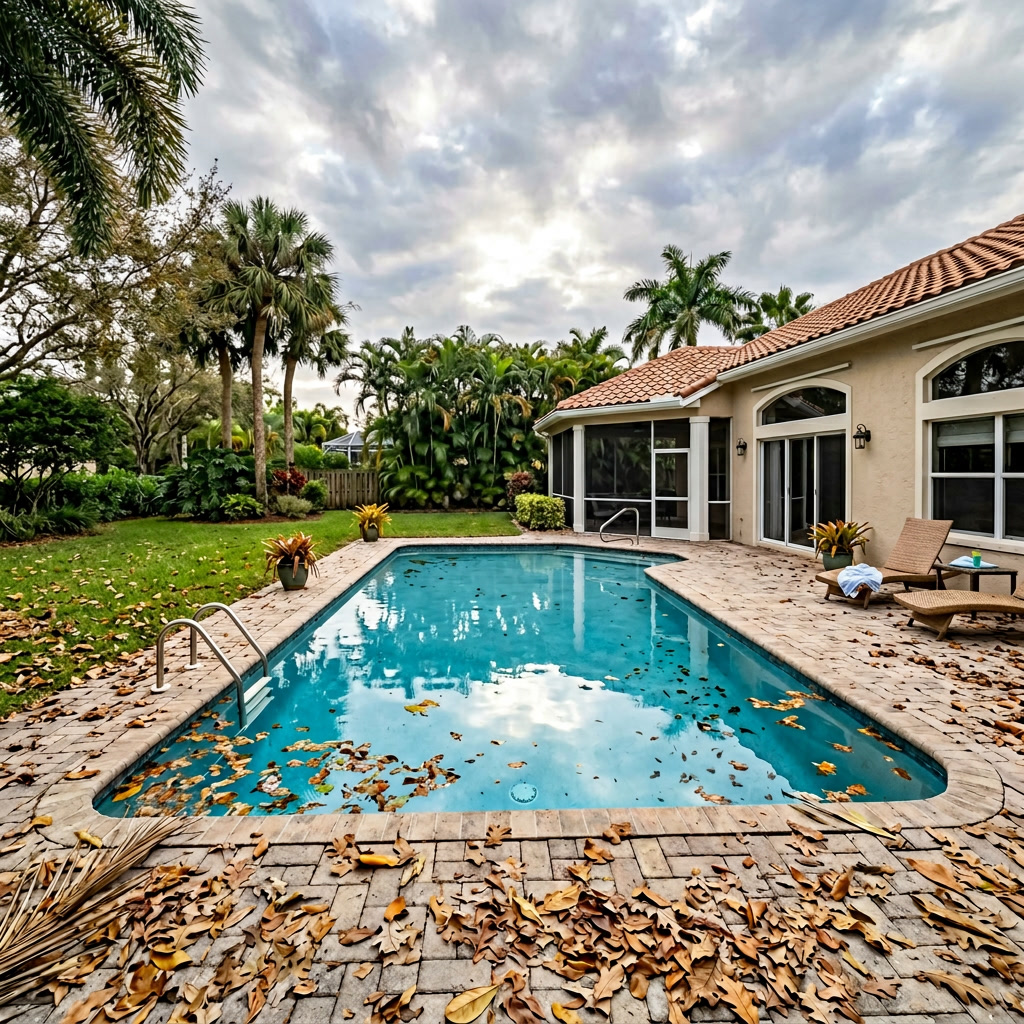
- Empty the skimmer basket: If your pool collects a lot of debris, a quick basket check prevents flow restriction. This is especially important during Jacksonville's fall season when leaves are heavy.
Weekly (30-45 Minutes)
This is your main maintenance session. Think of it as your pool's weekly checkup:
- Skim the entire surface to remove floating debris
- Brush the walls, steps, and tile line — even if they look clean, brushing prevents invisible algae biofilm from establishing
- Vacuum the floor manually or run your robotic cleaner
- Empty the skimmer and pump baskets
- Test water chemistry (chlorine, pH, alkalinity at minimum)
- Add chemicals as needed based on your test results
- Check the filter pressure gauge — clean the filter if pressure is 8-10 PSI above baseline
- Inspect the equipment pad for leaks, unusual sounds, or anything out of the ordinary
Monthly (15-20 Minutes)
- Test cyanuric acid (stabilizer) and adjust if needed
- Test calcium hardness — target 200-400 ppm
- Test phosphates — if above 300 ppb, treat with a phosphate remover
- Deep clean the filter (cartridge rinse, sand backwash, or DE recharge)
- Inspect your pool cleaner for worn parts, tangled hoses, or reduced performance
- Check the water level — it should be at the midpoint of your skimmer opening. In Jacksonville, evaporation can lower your water level by half an inch to an inch per week during summer
Seasonally
- Spring: Increase pump run time as temperatures rise. Check stabilizer levels after winter dilution from rain. This is a great time for a professional equipment inspection.
- Summer: Run the pump 10-12 hours daily. Test chemicals more frequently. Be prepared to add extra chlorine after afternoon thunderstorms, which are almost daily in Jacksonville from June through September.
- Fall: Watch for increased leaf debris. Adjust pump run time as temperatures cool. Clean the pool screen enclosure if debris is building up on the mesh.
- Winter: Reduce pump run time to 6-8 hours. Maintenance doesn't stop — algae slows down but doesn't disappear in Northeast Florida's mild winters.
Common Beginner Mistakes and How to Avoid Them
Every new pool owner makes mistakes — it's part of the learning curve. But knowing the most common pitfalls can save you real money and frustration. Here are the pool maintenance 101 mistakes we see most often.
Mistake #1: Neglecting the Pool for "Just a Couple Weeks"
This is the number one mistake, and in Jacksonville's climate, it's punishing. Two weeks of no maintenance during summer can turn a crystal-clear pool into a green swamp. Algae doubles every few hours in warm, nutrient-rich water. What would have cost $10 in weekly chlorine can turn into a $300 to $500 green pool recovery.
The fix: Stick to your weekly routine no matter what. If you're going on vacation, arrange for someone to check the pool or hire a temporary service.
Mistake #2: Adding Chemicals Without Testing First
Dumping chlorine into the pool "because it's been a while" without testing first can cause serious problems. Over-chlorination irritates skin and eyes, and adding acid when your pH is already low can damage your pool surface. Similarly, adding stabilizer when it's already high makes your chlorine ineffective.
The fix: Always test before you treat. It takes 15 seconds with a test strip and prevents costly overcompensation.
Mistake #3: Running the Pump Too Few Hours
Your pump needs to circulate all the water in your pool at least once per day. For a typical 15,000-gallon pool with a pump moving 60 gallons per minute, that's about 4 hours for one turnover. But one turnover isn't really enough — you need 1.5 to 2 turnovers for proper sanitation, which means 6 to 8 hours minimum, and 10 to 12 during peak summer. Running the pump for only 4 hours to save on electricity is a false economy when you end up spending more on chemicals and algae treatment.
The fix: Set your timer to run the pump during daylight hours when UV is breaking down chlorine and the water temperature is highest. If you have a variable-speed pump, run it at low speed for longer rather than high speed for shorter.
Mistake #4: Ignoring the Filter
Your filter is silently doing heavy lifting every day, and it's easy to forget about it. A dirty filter can't clean your water properly, increases energy costs, and puts strain on your pump. We've seen homeowners who never cleaned their filter for an entire year — by then, the cartridge was destroyed and the pump was on its last legs.
The fix: Check the pressure gauge weekly. Clean the filter when pressure rises 8-10 PSI above baseline. Most filters need a thorough cleaning every 1 to 3 months depending on usage and debris load.
Mistake #5: Shocking the Pool During the Day
Chlorine shock (especially liquid chlorine and calcium hypochlorite) is rapidly destroyed by UV sunlight. If you shock your pool at noon on a sunny Jacksonville day, you could lose 50 percent or more of the chlorine before it ever gets a chance to do its job.
The fix: Always shock in the evening after sunset. This gives the chlorine all night to work in the water at full strength before the sun comes back up.
Mistake #6: Draining the Pool Without Professional Guidance
Some new pool owners think draining the pool is a good way to "start fresh." This is actually one of the most dangerous things you can do. In Jacksonville and St. Johns County, our water table is high. An empty pool can literally float out of the ground due to hydrostatic pressure, cracking the shell and destroying the deck. Replastering alone costs $5,000 to $15,000 — and structural damage from a pop-up can cost far more.
The fix: Never drain your pool without consulting a professional. In most cases, partial draining and dilution can solve chemistry issues without the risks of a full drain.
When to Handle It Yourself vs Hiring a Pro
One of the biggest questions in any new pool owner guide is whether to DIY or hire a professional service. The honest answer is: it depends on your time, comfort level, and budget.
Good Candidates for DIY
Pool maintenance can be a satisfying weekend activity if you enjoy hands-on work. DIY makes sense if:
- You have 30 to 60 minutes per week to dedicate to pool care
- You're willing to learn about water chemistry and keep consistent records
- Your pool is relatively simple (no complex water features, salt systems, or automation)
- You enjoy the process and find it relaxing
Estimated DIY cost: $50 to $100 per month in chemicals and supplies, plus the upfront cost of equipment ($100 to $200 for basics, $500 to $1,200 if you add a robotic cleaner).
When Hiring a Pro Makes More Sense
Professional pool service is the better choice if:
- Your schedule is unpredictable and you can't guarantee weekly maintenance
- You'd rather spend your free time enjoying the pool, not maintaining it
- Your pool has complex equipment (salt chlorine generators, variable-speed pumps, automation systems, heaters) that benefits from trained eyes
- You want someone who catches small problems before they become expensive emergencies
- You've tried DIY and found yourself falling behind
Estimated professional service cost: $120 to $200 per month for weekly service with chemicals included.
The Hybrid Approach
Many Jacksonville pool owners find a middle ground: they handle the basic weekly skimming, brushing, and basket emptying themselves, and hire a professional for monthly chemical balancing, filter cleaning, and equipment inspections. This can save money while still ensuring the technical aspects of pool care are handled by someone with experience.
Always Call a Pro For These Situations
Regardless of your approach, some situations call for professional help:
- Green pool recovery or persistent algae problems
- Equipment repair or replacement (pumps, filters, heaters, salt cells)
- Plumbing leaks — especially underground leaks that require pressure testing
- Acid washing or resurfacing
- Any electrical work related to pool lighting or equipment
- Persistent water chemistry issues you can't resolve after multiple attempts
Ready to take the stress out of pool ownership? Whether you're a brand-new pool owner looking for guidance or you've decided professional maintenance is the way to go, RightWay Pool is here to help. We serve homeowners throughout Jacksonville and St. Johns County with reliable, transparent weekly pool care. Our technicians are happy to walk you through your pool system, answer your questions, and make sure your pool stays clean and swim-ready all year long. Contact RightWay Pool today for a free estimate — and ask about our beginner pool care tips delivered straight to your inbox.