The Number That Quietly Wrecks Pools
There's a chemistry reading in your pool that most pool stores avoid talking about. It doesn't show up on most test strips. It builds up slowly over months. And if it climbs past a certain point, your chlorine essentially stops working no matter how much you add.
That number is cyanuric acid, almost always written as CYA. Sometimes called "stabilizer" or "conditioner."
In St. Johns and across most of Florida, it's the single most common reason a pool that "should be fine" turns green in mid-summer with high chlorine readings.
Here's what CYA does, why it builds up here faster than most regions, what level you should actually be at, and how to fix it once it's too high.
What CYA Does
CYA is a chemical that bonds to chlorine in water and protects it from UV destruction.
Without CYA, free chlorine in a Florida pool would burn off in about 2 hours of direct sun. With CYA at 40 ppm, the same chlorine lasts most of a day. That's the whole reason CYA exists in pool chemistry.
The standard recommendation: 40 to 60 ppm CYA in a regular chlorine pool. 60 to 80 in a salt pool. Outside those ranges, things go wrong.
What Goes Wrong Above 80 ppm
Here's the dirty secret that pool stores rarely explain.
CYA doesn't just protect chlorine. It also weakens chlorine's killing power. The more CYA in the water, the less effective each unit of chlorine becomes.
The math, roughly:
- At 40 ppm CYA with 3 ppm free chlorine: chlorine is fully effective. Algae has no chance.
- At 80 ppm CYA with 3 ppm free chlorine: chlorine effectiveness drops by about half.
- At 120 ppm CYA with 3 ppm free chlorine: chlorine is essentially neutralized. Algae grows freely.
This explains every St. Johns homeowner who tests their water, sees 4 ppm chlorine, and is staring at green water anyway. CYA is over 100 and the chlorine reading is meaningless.
Why CYA Climbs So Fast in Florida Pools
Three main reasons:
Stabilized chlorine tablets
The most common pool chemical in America is the 3-inch tablet. Almost all of them are "trichlor" or "dichlor" — both contain CYA. Every tablet you drop into a chlorinator adds roughly 0.6 ppm of CYA to a 20,000 gallon pool.
If you use 1 tablet per week for 12 months, you've added about 30 ppm of CYA in a year. After 3 years of weekly tablets, your CYA is at 90+ ppm before you've done anything else.
This is the silent killer of tablet-based pools.
"Shock" products that contain dichlor
Many bagged shock products are dichlor (sodium dichloroisocyanurate). Every dose adds CYA. If you shock weekly with dichlor for a summer, you've added 30 to 60 ppm of CYA in one season.
Lack of dilution
Pool water doesn't really leave the pool. Evaporation removes water but leaves CYA behind. The only way to remove CYA is to physically drain water out and refill with fresh water.
In Florida, where we get lots of summer rain, you'd think this dilutes CYA. It does, slightly. But rainwater overflow rarely removes enough volume to actually move the needle. Most rain just raises the level, then evaporates out, leaving CYA right where it was.
How to Actually Test CYA
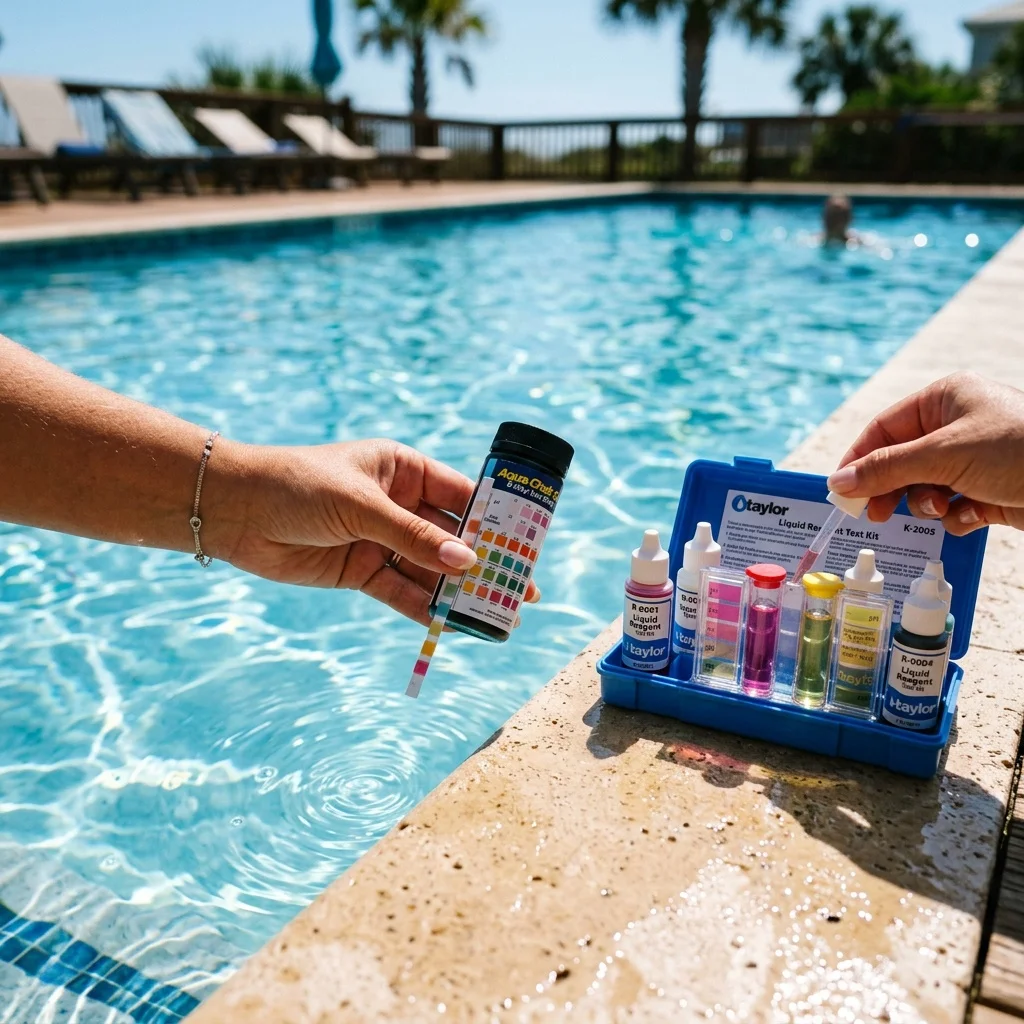
This is critical. Many test strips do not include CYA. The ones that do are notoriously inaccurate.
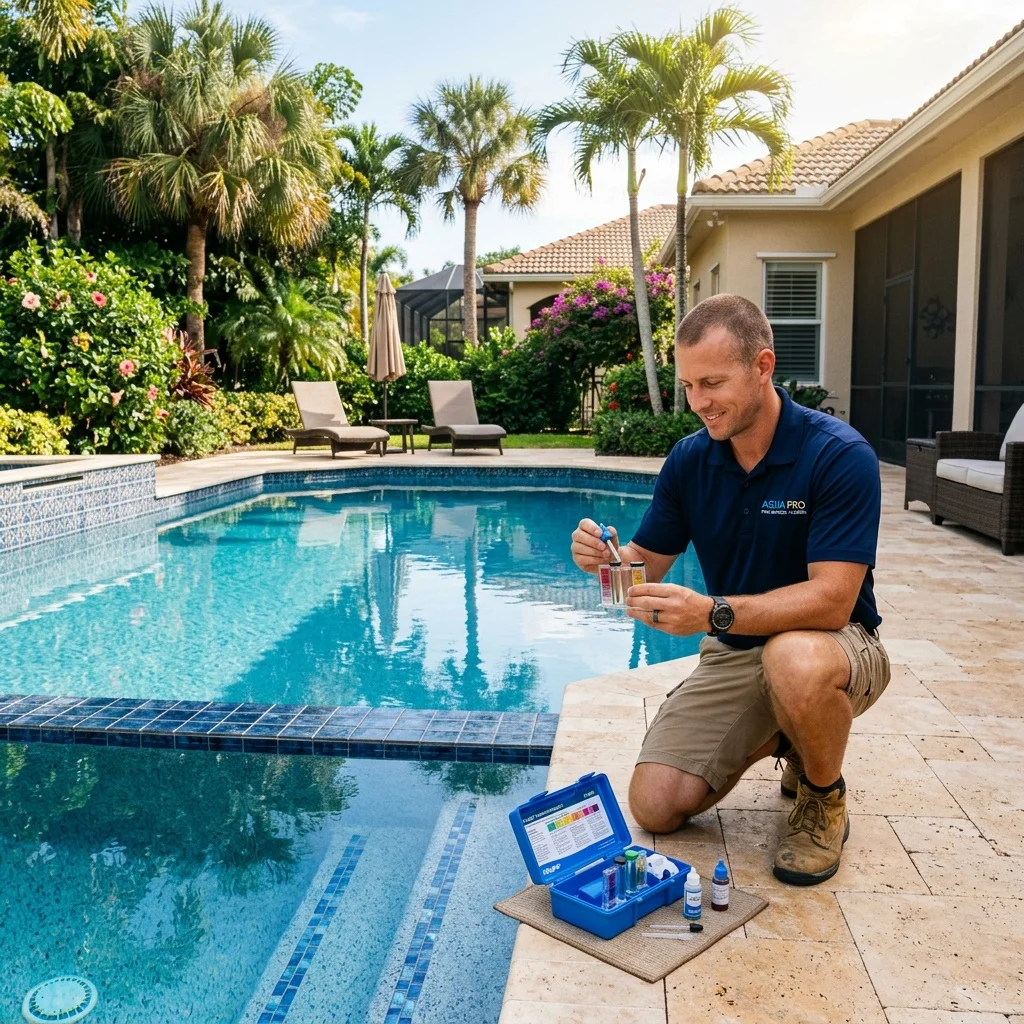
The reliable test is a "turbidity" test using melamine reagent. You add a drop of reagent to a sample tube. The cloudier the sample, the higher the CYA. Match the cloudiness to a vertical line on the tube.
- Taylor K-2006 test kit: comes with this.
- TFTest Kits TF-100: also has it.
- AquaChek 7-way strips: include CYA but read low. Add 30 to whatever the strip says for a more realistic number.
If your pool store does free water testing, ask for CYA specifically. Half of them skip it unless you ask.
What to Do If CYA Is Too High
There's no chemical that removes CYA. None. Anyone who tells you otherwise is selling you a $40 bottle of nothing.
The only options:
Partial drain and refill
For most St. Johns pools with CYA at 100-120, draining 25 to 30 percent of the pool water and refilling brings CYA down to 70 to 80. That's usually enough.
How to do it:
- Run a submersible pump or open the drain valve.
- Drop the water level 25 percent (approximately to the bottom of the tile line, then a few inches more).
- Refill from the hose to full.
- Retest CYA in 24 hours after the pool has mixed.
Cost: about $30 to $50 in increased water bill plus a Saturday morning.
Reverse osmosis treatment (for severe cases)
If CYA is over 200 ppm, a partial drain won't get it low enough. Companies in Florida offer mobile reverse osmosis (RO) service that removes CYA without losing water. They roll up a trailer, run your pool water through filters, and bring CYA down to normal in one visit.
Cost: typically $400 to $700 for a 20,000 gallon pool. Worth it when the alternative is a full drain (which has its own risks).
Full drain (last resort)
Empty the pool entirely and refill. Cheaper than RO but risky in Florida: an empty pool can pop out of the ground due to groundwater pressure, especially in newer Nocatee and RiverTown subdivisions built on lower elevation.
Never empty a Florida pool without a pool pro on site to handle hydrostatic relief and re-startup chemistry.
How to Prevent High CYA in the Future
If you've just done a partial drain and you don't want to do this again in 18 months:
- Stop using stabilized chlorine tablets as your primary chlorine source. Switch to liquid chlorine or salt.
- If you must use tablets, alternate weeks with liquid chlorine.
- Use cal-hypo or liquid chlorine for shock, never dichlor.
- Test CYA every 3 months. If it's climbing past 70, plan a partial drain before the next summer.
In a properly managed pool, CYA should stay in the 40 to 60 range for years.
The Honest Summary
If your pool has been on weekly tablets for several years and you've never tested CYA, there's a good chance your number is well over 80. The first move is to actually measure it. Once you know, the path forward is clear: partial drain, switch off tablets, watch the level.
Want a real CYA test and a plan to bring it down without trial and error? Book a pool service in St. Johns, FL and we'll pull a full water panel, measure CYA accurately, and tell you whether you need a partial drain or a chemical strategy change.