The Reading Everyone Underrates
Walk into ten pool conversations and nine of them are about chlorine. Is the chlorine high enough. Is the chlorine too low. What kind of chlorine. Tablets vs. liquid vs. salt.
Almost none of them are about pH. And almost every actual pool problem in St. Johns — itchy eyes, cloudy water, dead chlorine, scaling tile, corroded heaters, ineffective algaecides — traces back to pH being out of range.
If you only had time to test one thing weekly, you'd test pH.
Here's why, and how to keep it in range without becoming a chemistry student.
What pH Actually Is (Quick Version)
pH measures how acidic or basic the water is, on a 0 to 14 scale. 7.0 is neutral. Below 7 is acidic. Above 7 is basic (alkaline).
Pool target: 7.4 to 7.6. Slightly basic, matching the pH of human tears and human eyes. That's not a coincidence; that's why a pool at 7.5 doesn't sting and a pool at 8.0 burns your eyes.
The scale is logarithmic. A pool at 8.0 isn't "a little higher" than 7.5. It's about 3 times more basic. Small numerical changes mean big chemistry changes.
Why pH Matters More Than the Chlorine Number
Three reasons. None of them are usually explained at the pool store.
1. pH determines if chlorine actually works
Free chlorine in water exists in two forms: hypochlorous acid (HOCl) and hypochlorite ion (OCl-). HOCl is the killer; OCl- is much weaker.
The ratio between them is pure pH.
- At pH 7.0, about 75 percent of your chlorine is HOCl (effective).
- At pH 7.5, about 50 percent is HOCl (still good).
- At pH 8.0, only about 22 percent is HOCl (barely working).
- At pH 8.2, you're below 20 percent. You can have 5 ppm free chlorine and the pool will still go green.
This is the answer to the most common St. Johns complaint: "My chlorine is high and the pool is still cloudy." Almost always, pH crept past 7.8 and the chlorine isn't actually doing anything.
2. pH controls scaling and corrosion
Pool surfaces, tiles, plaster, and equipment all live or die by pH.
- pH below 7.0 corrodes metal heater parts, eats away grout, etches plaster, and can leach copper from heater cores (which then stains hair green and the pool plaster blue).
- pH above 7.8 deposits calcium carbonate scale on tile, plaster, and the inside of heaters and salt cells. Once it scales, you're looking at acid washes, salt cell cleanings, and shortened equipment life.
A pool kept in 7.4 to 7.6 protects every dollar of equipment underneath the deck. A pool drifting between 7.0 and 8.2 quietly destroys things over months.
3. pH affects swimmer comfort
Red eyes, itchy skin, that "chlorine smell" you remember from public pools — none of those are about how much chlorine is in the water. They're all pH-driven.
Real chlorine, properly balanced at the right pH, has almost no smell. The strong "chlorine pool" smell is chloramines (combined chlorine), which only build up when free chlorine isn't doing its job, which happens when pH is too high.
If your pool burns eyes or has a strong smell, you have a pH problem masquerading as a chlorine problem.
Why pH Drifts in St. Johns
Three local factors:
City fill water runs alkaline. St. Johns County tap water typically tests pH 7.6 to 8.2 when it leaves the tap. Every evaporation top-off pushes your pool's pH slightly up. Over a summer that adds up.
CO2 escapes constantly. Pool water naturally outgasses carbon dioxide, which is acidic. Less CO2 in solution means higher pH. Anything that agitates water (waterfalls, deck jets, fountain returns) speeds it up. If you have a water feature running, your pH wants to climb daily.
Cal-hypo shocks raise it. Calcium hypochlorite (the most common bagged shock) is highly alkaline. Every shock dose pushes pH up. Pools that shock weekly with cal-hypo are constantly fighting pH drift.
Rain drops it. A heavy thunderstorm dilutes the pool with relatively acidic rainwater. After big storms, pH can drop half a point overnight.
The natural drift in St. Johns is upward. Most days you're managing how to push pH back down, not up.
How to Keep pH in Range
Test twice a week
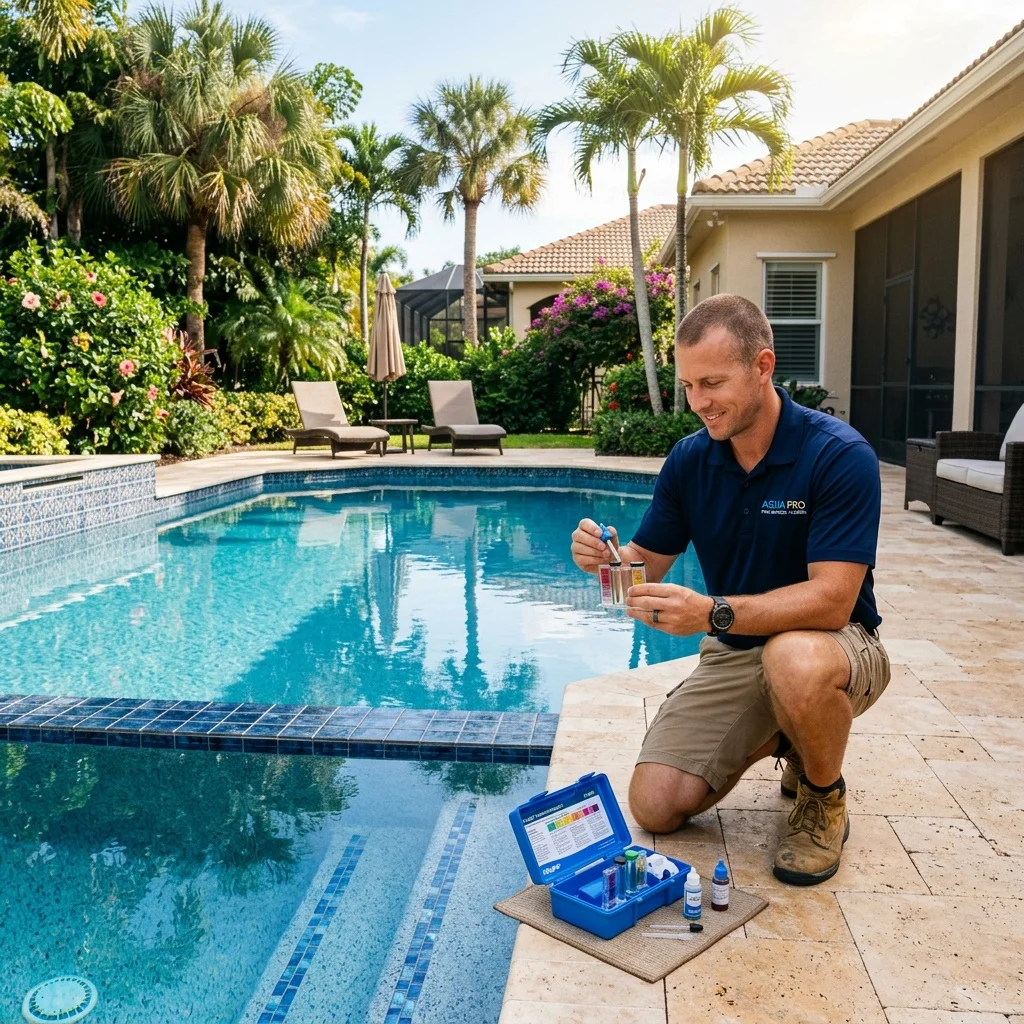
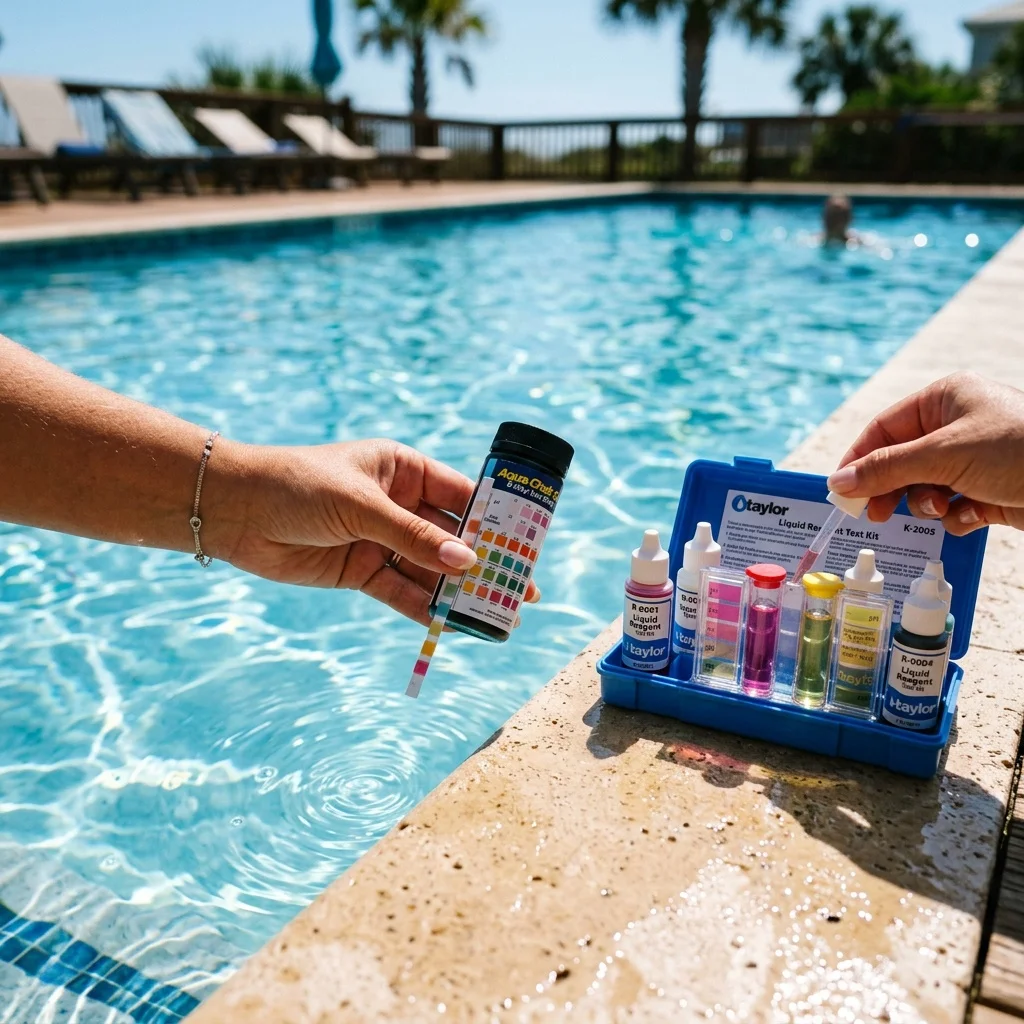
Once a week isn't enough during spring and summer. Test Sunday and Wednesday. Five minutes with a drop kit (the yellow phenol red drops) is more accurate than test strips for pH.
Use muriatic acid to lower pH
For most St. Johns pools, this is your primary chemical adjustment. Muriatic acid (hydrochloric acid, 31 percent) brings pH down quickly. Dose carefully: for a 20,000 gallon pool, 1 cup of muriatic acid drops pH about 0.2.
Safety: gloves, eye protection, never pour acid into water near the return jet (high local concentration), dose with the pump running, retest after 4 hours.
Some pools use dry acid (sodium bisulfate) instead of muriatic. It's safer to handle but raises sulfates over time, which can damage salt cells. For weekly use in salt pools, stick with muriatic.
Use sodium carbonate (washing soda) to raise pH only if needed
Some pools, especially heavily-rain-diluted ones, occasionally need pH raised. Sodium carbonate (washing soda) does it without affecting alkalinity much.
Watch alkalinity together
Total alkalinity is the buffer that keeps pH stable. If alkalinity is too high (above 120 ppm), pH will keep wanting to climb. If alkalinity is too low (below 60), pH will swing wildly with any small change.
Keep alkalinity 80 to 100 for a stable pool.
Watch CYA in salt pools
In salt pools, the salt cell generates chlorine through electrolysis. That process is slightly basic, so salt pools climb pH faster than tablet pools. Plan for more frequent acid additions in summer.
What to Stop Doing
A few common St. Johns habits that make pH worse:
- Shocking weekly with cal-hypo. Switch to liquid chlorine.
- Topping off the pool from the tap without retesting pH within 24 hours.
- Running a waterfall 12 hours a day in summer "for ambiance." It will cost you a $40 jug of acid every two weeks.
- Trusting pool-store advice to raise alkalinity without testing pH first. St. Johns pools almost never need alkalinity raised; they need it dropped.
- Letting pH drift "until next weekend." pH problems compound. A 7.9 reading Tuesday is an 8.2 reading Sunday.
A Simple Weekly Routine
For most St. Johns homeowners who want to keep this manageable:
- Sunday morning: test pH and free chlorine. Adjust pH first, chlorine second.
- Wednesday morning: test pH only. Adjust if it crept up.
- Monthly: test alkalinity, calcium hardness, CYA.
- After every heavy rain: test pH within 24 hours.
- After every shock dose: test pH the next morning.
Want the pH conversation handled for you every week? Book a pool service in St. Johns, FL and we'll handle the testing, the adjustments, and the chemistry decisions, with a written report after every visit.