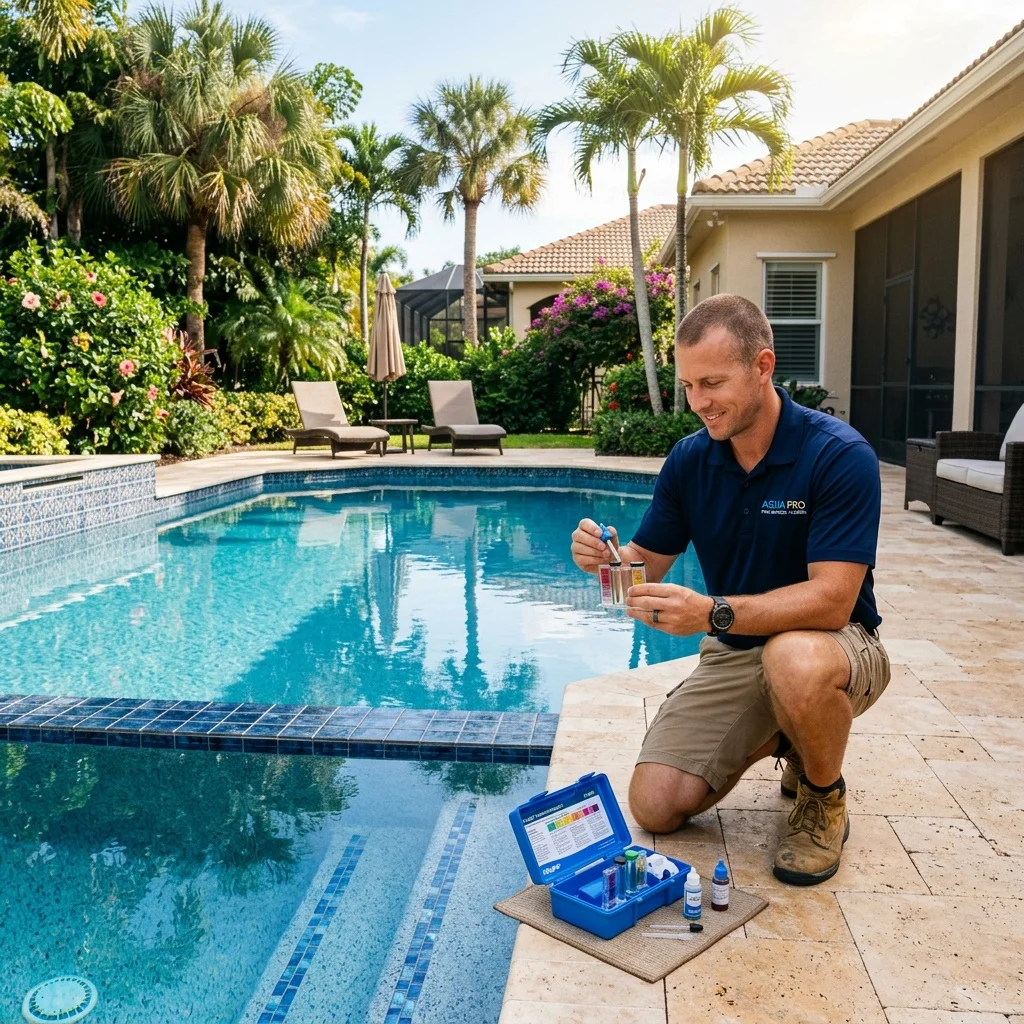
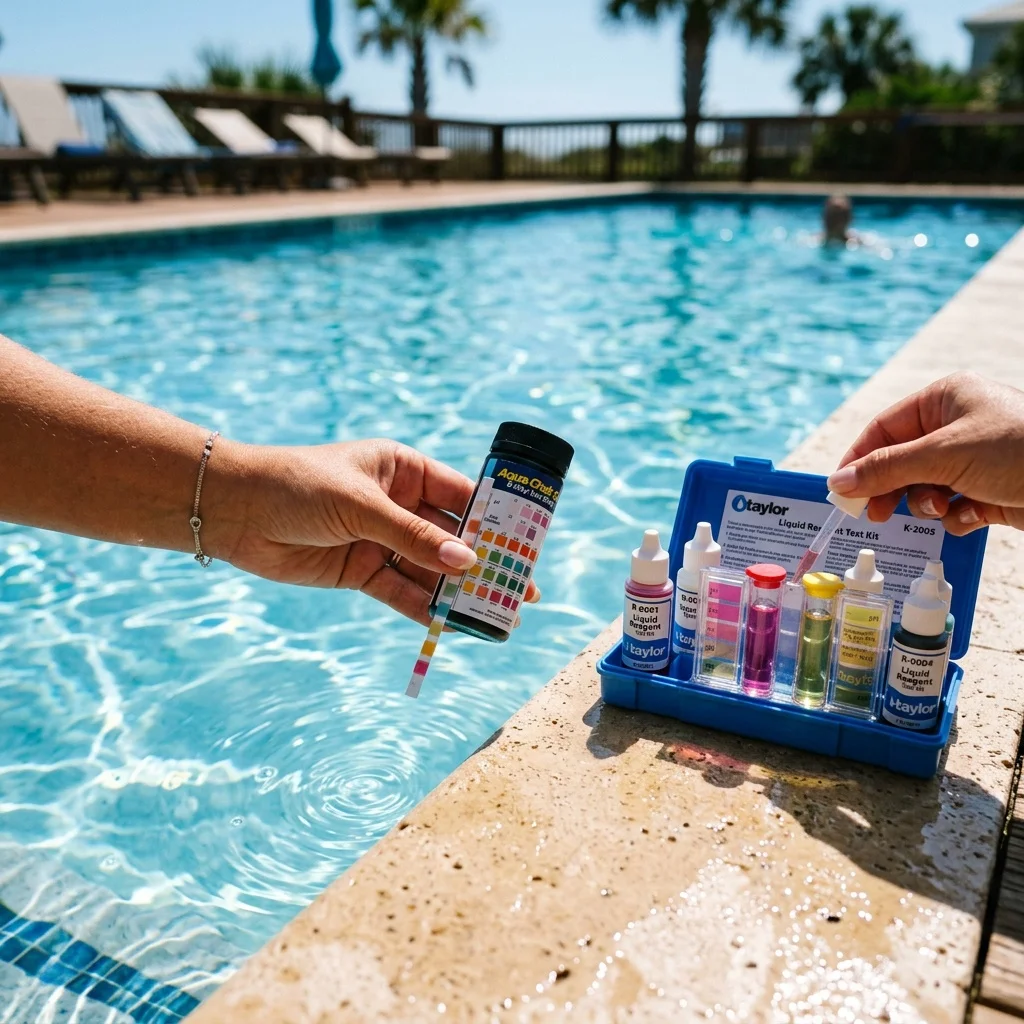
The Question Everyone Asks Wrong
You walk into a pool store with cloudy water. They sell you a bag of shock. They say "shock once a week." You do that for three months. Your calcium hardness is now at 600 ppm, your CYA is at 110, and the pool is still cloudy.
The right question isn't "how often should I shock." It's "what am I actually trying to do, and is shocking the right tool for it?"
In a Jacksonville summer, most pools need either weekly shock or no shock — and which one depends on five things you can measure. Here's the honest version.
What "Shock" Actually Means
"Shock" is shorthand for raising free chlorine to roughly 10 times your combined chloramine level. The goal isn't to add a giant dose for the sake of it; the goal is to push past breakpoint chlorination so that all the combined chlorine (chloramines, the stuff that smells like a public pool) gets oxidized into the air.
Products labeled "shock" usually contain one of three things:
- Calcium hypochlorite (cal-hypo). Strong shock, raises calcium hardness with each dose. The most common bag in pool stores.
- Sodium dichlor. Strong shock, adds CYA (stabilizer) with each dose. Good for cool-month pools that need CYA. Bad for July, when CYA is usually already too high.
- Liquid sodium hypochlorite. Strong shock, no calcium added, no CYA added. The cleanest option for Florida pools long-term. Just bleach in pool concentration.
The problem with "shock every week" advice is that two of these three options stack up something your pool doesn't need over time.
What Determines Shock Frequency in a Jax Summer
Five inputs matter more than any pool-store rule:
1. Bather load
If you have three kids, two cousins visiting, and a Memorial Day pool party, your pool just absorbed a few pounds of sweat, sunscreen, and oils. Shock the day after a heavy use weekend, every time.
2. Combined chlorine (CC) reading
If you can measure free chlorine and total chlorine separately, combined chlorine is the difference. CC over 0.3 ppm means it's time to shock. CC under 0.2 ppm means shocking is unnecessary; you'd be raising FC for nothing.
3. Rain and storms
A heavy storm dilutes chlorine and dumps phosphate-rich debris in the water. Shock within 24 hours of any storm that drops more than an inch.
4. UV intensity
Jacksonville summer sun destroys unprotected chlorine in about 2 hours. If your CYA is too low (under 30 ppm), you're losing chlorine faster than you can add it, and shock becomes a daily exercise. If your CYA is in range (40 to 70 ppm), the chlorine you add sticks around long enough to do its job.
5. CYA level
Here's the dirty secret of summer pool maintenance: if your CYA has climbed past 80 ppm (very common in pools using tablets), you have to shock at much higher levels just to break through. Some pools with CYA over 100 are effectively un-shockable without a partial drain first. A test kit that reads CYA is worth more than a year of shock bags.
The Honest Frequency Range
Assuming reasonable chemistry (FC 2-4, pH 7.4-7.6, CYA 40-70, CH 250-400):
- No party, no storm, CC at 0: Shock once every 2 weeks. Maintenance, not necessity.
- Normal week with kids in the pool 3-4 times: Shock once a week.
- Pool party day: Shock the night after, every time. Run pump 12 hours.
- After a thunderstorm with more than an inch of rain: Shock within 24 hours.
- Algae bloom (visible green or yellow): Shock at 3x normal dose and brush thoroughly. Repeat 24 hours later if not fully cleared.
- Pool sat closed for a week (vacation): Shock the day you come home.
If your pool is on weekly professional service, the technician handles all of this for you, and you usually don't need to add shock between visits.
The Cal-Hypo Trap
A lot of pool stores will sell you a bag of cal-hypo every single visit. Cal-hypo has roughly 40 percent calcium by weight. If you're shocking weekly with cal-hypo, you're adding about 50 ppm of calcium to your pool every month.
Math after 12 months: your calcium hardness goes from 250 to 850. That's where scale comes from. That's why your tile has a white crust. That's why your salt cell is making smaller and smaller bubbles.
If you're shocking weekly, switch to liquid chlorine. A gallon of pool-grade liquid chlorine (12.5 percent strength) shocks the same 20,000 gallon pool as a bag of cal-hypo, costs about the same, and adds zero calcium. The only downside is you have to handle a liquid jug.
When You Should Stop Shocking and Fix the Real Problem
A few signs that shocking is the wrong move:
- Your free chlorine drops to zero within 24 hours of a heavy shock. This means CYA is too high (over 100) and chlorine can't stay active. Partial drain and refill is the fix.
- Your pool is cloudy even with FC at 5 ppm. Cloudy water at high chlorine is usually a filter problem, not a chlorine problem. Clean the filter, recheck.
- You shock and the water turns from green to gray-cloudy. That's metal precipitation (iron or copper). Adding more chlorine makes it worse. You need a metal sequestrant first.
- Phosphates are above 500 ppb. Shock kills algae, but if phosphates are sky-high, the algae comes back in 4 days. Treat phosphates first, shock second.
The Easiest Summer Routine
If you want a single rule that works for most St. Johns pools through summer:
- Test free and total chlorine twice a week.
- If CC is over 0.3 ppm, shock that night.
- After every party and every heavy storm, shock that night.
- Use liquid chlorine, not cal-hypo, unless your calcium hardness is genuinely low.
- Test CYA once a month. If it climbs past 80, partial-drain instead of shocking harder.
Don't want to track all of this? Book a pool service in St. Johns, FL and we'll handle the chemistry decisions, including when to shock and when to leave it alone, with a written report after every visit.