Understanding Your Pool's Water Chemistry
If you're a pool owner in Jacksonville or St. Johns County, water chemistry might seem intimidating at first. There are so many numbers to track, chemicals to add, and things that can go wrong. But at its core, pool water chemistry is about maintaining a few key parameters within their ideal ranges. Get those right, and everything else falls into place.
Think of pool chemistry like a recipe. Each ingredient has a specific purpose, and they all work together. Change one, and it affects the others. This guide will help you understand what each parameter does, why it matters, and how to keep everything in balance.
Free Chlorine: Your Pool's Immune System
Ideal range: 2-4 ppm (parts per million)
Chlorine is the most important chemical in your pool. It's your sanitizer — the substance that kills bacteria, viruses, and algae to keep the water safe for swimming. Without adequate chlorine, your pool becomes a breeding ground for harmful microorganisms within hours.
How Chlorine Works
When you add chlorine to your pool, it dissolves into the water and forms hypochlorous acid (HOCl). This is the "active" form of chlorine that does the actual sanitizing. It attacks the cell walls of bacteria and algae, destroying them on contact.
As chlorine does its job, it gets "used up." It combines with contaminants like sweat, sunscreen, urine, and organic debris to form chloramines, also known as "combined chlorine." Chloramines are that harsh "chlorine smell" people associate with pools — ironically, a strong chlorine smell usually means there's not enough free chlorine, not too much.
Types of Chlorine
- Liquid chlorine (sodium hypochlorite): Fast-acting and easy to use. The most common type used by professional pool services in Florida. Doesn't add stabilizer, so it's ideal for pools that already have adequate cyanuric acid levels.
- Granular shock (calcium hypochlorite): Powerful and fast-dissolving. Great for shock treatments. Raises calcium hardness slightly with each use.
- Chlorine tablets (trichlor): Slow-dissolving tablets used in floating dispensers or inline chlorinators. Convenient for maintaining a baseline chlorine level between services. Contains stabilizer, so long-term exclusive use can cause stabilizer buildup.
- Dichlor: Fast-dissolving granular chlorine that also contains stabilizer. Good for initial stabilizer buildup or hot tubs.
Maintaining Proper Chlorine Levels
In Jacksonville's warm, sunny climate, chlorine demand is high. To maintain 2-4 ppm:
- Run your pump long enough each day to circulate all the water (turnover rate)
- Ensure you have adequate cyanuric acid to protect chlorine from UV degradation
- Add chlorine regularly — don't wait for levels to drop to zero before adding more
- After heavy rain, test and supplement immediately
- Shock the pool weekly during summer or after heavy use
pH: The Master Controller
Ideal range: 7.4-7.6
pH is a measure of how acidic or basic (alkaline) your water is, on a scale from 0 to 14. A pH of 7.0 is neutral, below 7.0 is acidic, and above 7.0 is basic. For swimming pools, slightly basic water at 7.4-7.6 is ideal.
Why pH Is So Important
pH affects virtually everything in your pool:
Chlorine effectiveness: At a pH of 7.2, about 63% of your chlorine is in its active, sanitizing form. At 7.8, only about 32% is active. At 8.0, it drops to around 21%. This means you could have a strong chlorine reading but still have algae problems simply because your pH is too high for the chlorine to work properly.
Swimmer comfort: Human eyes and mucous membranes have a natural pH of about 7.4. Water at this pH feels comfortable. Stray too far in either direction, and swimmers experience eye irritation, dry skin, and discomfort.
Surface and equipment protection: Low pH (acidic water) corrodes metal fixtures, etches plaster surfaces, and degrades equipment seals. High pH (basic water) causes calcium to precipitate out of solution, creating scale deposits on tile, inside pipes, and on equipment.
What Causes pH to Change?
- Rain: Jacksonville's frequent rain is slightly acidic (pH around 5.5), which lowers pool pH
- Chlorine type: Liquid chlorine and calcium hypochlorite raise pH; trichlor tablets lower it
- Swimmers: Sweat, body oils, and sunscreen tend to lower pH
- Aeration: Water features, spillovers, and spa jets add oxygen to the water, which raises pH
- Carbon dioxide off-gassing: As CO2 leaves the water, pH rises
Adjusting pH
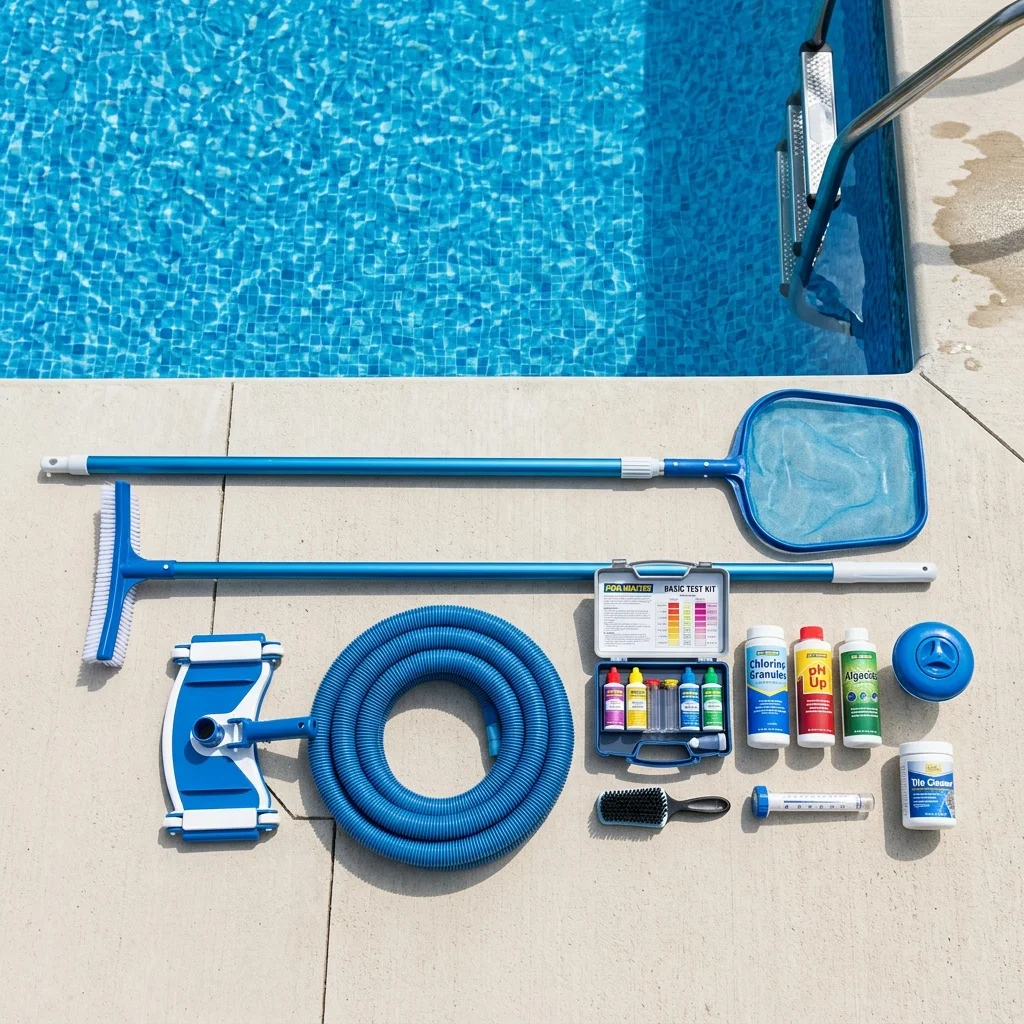
- To lower pH: Add muriatic acid or dry acid (sodium bisulfate). Add in small amounts, let it circulate for an hour, then retest.
- To raise pH: Add soda ash (sodium carbonate). Again, add gradually and retest.
Important: Always adjust alkalinity before trying to fine-tune pH. Alkalinity stabilizes pH, so if alkalinity is off, pH will be difficult to control.
Total Alkalinity: The pH Stabilizer
Ideal range: 80-120 ppm
Total alkalinity measures the water's ability to resist changes in pH — its "buffering capacity." Think of alkalinity as the shock absorber for your pH. With proper alkalinity, your pH stays relatively stable even when chemicals, rain, or swimmers are added to the pool.
What Happens When Alkalinity Is Wrong
Too low (below 80 ppm): pH becomes erratic, bouncing up and down with every small change. This is called "pH bounce," and it makes water chemistry nearly impossible to manage. You'll find yourself constantly adding acid or soda ash, chasing a moving target.
Too high (above 120 ppm): pH tends to drift upward and resist adjustment. The water may become cloudy as calcium carbonate precipitates, and scale formation accelerates. Chlorine efficiency decreases as pH climbs.
Adjusting Alkalinity
- To raise alkalinity: Add sodium bicarbonate (baking soda). It's inexpensive and widely available. Add 1.5 pounds per 10,000 gallons to raise alkalinity by approximately 10 ppm.
- To lower alkalinity: Add muriatic acid with the pump off, pouring it in one concentrated area (called "slug dosing"). This lowers alkalinity more than pH. Then aerate the pool (run water features or point a return jet upward) to bring pH back up without raising alkalinity.
Cyanuric Acid (Stabilizer/Conditioner)
Ideal range: 30-50 ppm
Cyanuric acid (CYA) is often called "sunscreen for chlorine." In Jacksonville's intense Florida sunshine, UV radiation destroys free chlorine at an alarming rate. Without stabilizer, you can lose all your chlorine in just two to three hours on a sunny day. CYA bonds with chlorine molecules, protecting them from UV breakdown while still allowing them to sanitize.
The Stabilizer Balancing Act
Too little stabilizer means you're wasting chlorine and money as the sun burns it off. Too much stabilizer actually reduces chlorine's ability to kill bacteria and algae, a problem known as "chlorine lock" or "over-stabilization."
At 30 ppm CYA, your chlorine is well-protected and still very effective. At 100 ppm or above, you need to maintain much higher chlorine levels to achieve the same sanitizing effect — effectively making your chlorine lazy.
Managing Stabilizer Levels
- To raise CYA: Add cyanuric acid (sold as "stabilizer" or "conditioner"). It dissolves slowly, so add it through the skimmer or a sock in front of a return jet.
- To lower CYA: The only effective method is dilution. Drain a portion of the pool and refill with fresh water. There are some CYA-reducing products on the market, but results vary.
Pro tip: If you use trichlor tablets as your primary chlorine source, monitor your CYA closely. Each tablet adds a small amount of stabilizer, and over a season, levels can creep well above 50 ppm without you adding any stabilizer directly.
Calcium Hardness: Often Overlooked
Ideal range: 200-400 ppm
Calcium hardness measures the amount of dissolved calcium in your water. While not tested as frequently as the others, it's important for protecting your pool surfaces and equipment.
Too low: The water becomes "aggressive," meaning it seeks calcium from other sources — your plaster, tile grout, and concrete deck. This leads to etching, pitting, and surface degradation.
Too high: Excess calcium precipitates out as scale — white, crusty deposits on tile, inside pipes, and on heat exchangers. In Jacksonville, where our municipal water tends to have moderate calcium levels, this is worth monitoring quarterly.
How All the Parameters Work Together
The real art of pool chemistry is understanding that these parameters are interconnected:
- Low pH makes chlorine more active but corrodes surfaces
- High alkalinity pushes pH upward, reducing chlorine effectiveness
- High stabilizer demands higher chlorine levels
- Low calcium hardness accelerates surface damage from acidic water
- Temperature amplifies everything — warmer water (like ours in Jacksonville) increases chemical reactions, chlorine demand, and algae growth
This is why testing regularly and making small, incremental adjustments is better than waiting for problems and making large corrections.
Recommended Testing Schedule
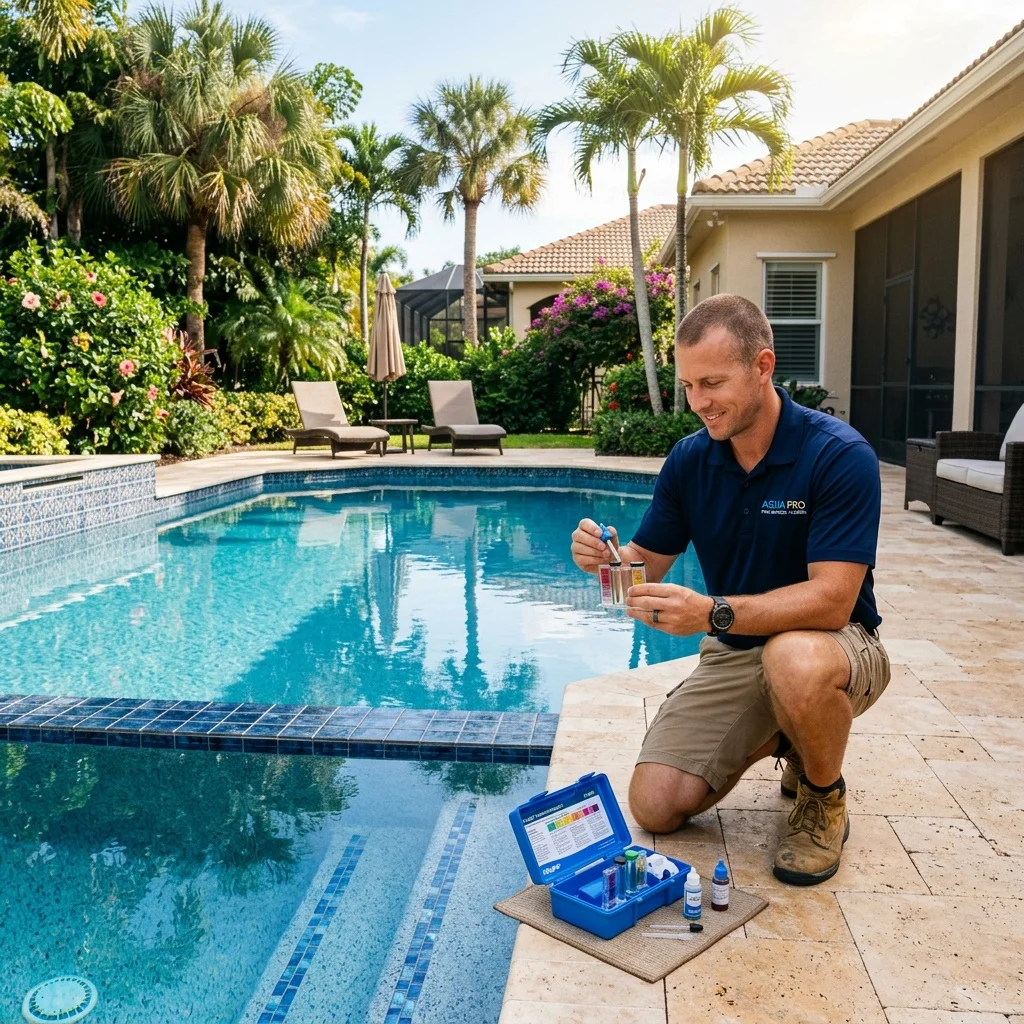
- Chlorine and pH: Test at least twice per week during summer, once per week in winter
- Alkalinity: Test weekly
- Cyanuric acid: Test monthly
- Calcium hardness: Test monthly
- Phosphates: Test monthly or when experiencing persistent algae
- Metals (copper and iron): Test if you notice staining or discoloration
Final Thoughts
Pool chemistry doesn't have to be overwhelming. Focus on the big three — chlorine, pH, and alkalinity — and test them consistently. Keep records so you can spot trends. And remember that small, regular adjustments are always better than large, reactive corrections.
Want to leave the chemistry to the experts? RightWay Pool tests and adjusts every critical parameter on every weekly visit. Our technicians are trained in water chemistry and keep detailed logs of your pool's history. Serving Jacksonville and St. Johns County with reliable, professional pool care. Reach out for a free estimate today.