The Storm Rolls Through, the Pool Gets Hazy
You walk out Tuesday evening and the pool is crystal clear. By Wednesday morning, after the standard St. Johns afternoon thunderstorm, it's hazy. The bottom drain looks softer than it did yesterday. The water has a slight gray-blue tinge.
This is one of the most common summer service calls in Northeast Florida. It's almost never as bad as it looks, but the way most homeowners react makes it worse.
Here's what's actually happening and how to clear the water in 48 hours without overcorrecting.
What a Thunderstorm Does to Your Pool
In a single hour of heavy rain, your pool absorbs:
- Several hundred gallons of relatively acidic rainwater (Florida rain is typically pH 5.5 to 6.5).
- Dust and pollen washed off your screen enclosure or pool deck.
- Tree debris that gets pushed past the skimmer baskets.
- Phosphates from lawn fertilizer runoff, especially if you're downhill from a freshly fertilized yard.
- A meaningful drop in chlorine as rainwater dilutes the pool by 1 to 3 percent.
Then the wind blows in:
- Mulch dust and pine straw bits from beds around the deck.
- Oak catkins and leaves from any tree within 50 feet.
- Cypress fronds and fine debris if you're near a pond or retention area.
All of that lands in the water at once. The pool that was perfectly balanced Tuesday now has lower chlorine, lower pH, higher phosphates, and a lot of suspended fine particles.
The cloudiness you see is mostly those fine particles. The chemistry shifts under the surface are what determine how fast you can clear it.
The Five Things to Check Within 12 Hours
Don't dump anything in yet. Test first, then act.
1. Free chlorine
Probably half what it was before the storm. If it's at or near zero, that's the first priority. Without chlorine, the suspended organic matter starts decomposing and feeding algae. You have a 24 to 48 hour window before things go from cloudy to green.
2. pH
Likely dropped 0.2 to 0.5. Rainwater is mildly acidic. If pH is below 7.2, you'll need to bring it back up. If it's still in 7.4 to 7.6 range, leave it alone.
3. Alkalinity
Storm rainfall can drop alkalinity 10 to 20 ppm. If it falls below 60, pH will swing dramatically with the next storm. Stabilize it now.
4. Skimmer baskets and filter
Likely overloaded. Both skimmer baskets are probably full. The filter might be plugged with the finer debris that got past the baskets. Pressure on the filter gauge is the tell: if it's more than 8 psi above clean baseline, the filter needs servicing.
5. Visible debris
Are there leaves on the bottom? Mulch dust in the corners? Pollen film on the surface? Note what you're dealing with so you can clear it physically, not chemically.
The 48-Hour Recovery Routine
This is what professional service does in the post-storm visit. You can replicate it at home.
Hour 0 (Test and Skim)
- Clean both skimmer baskets.
- Skim the surface with a net.
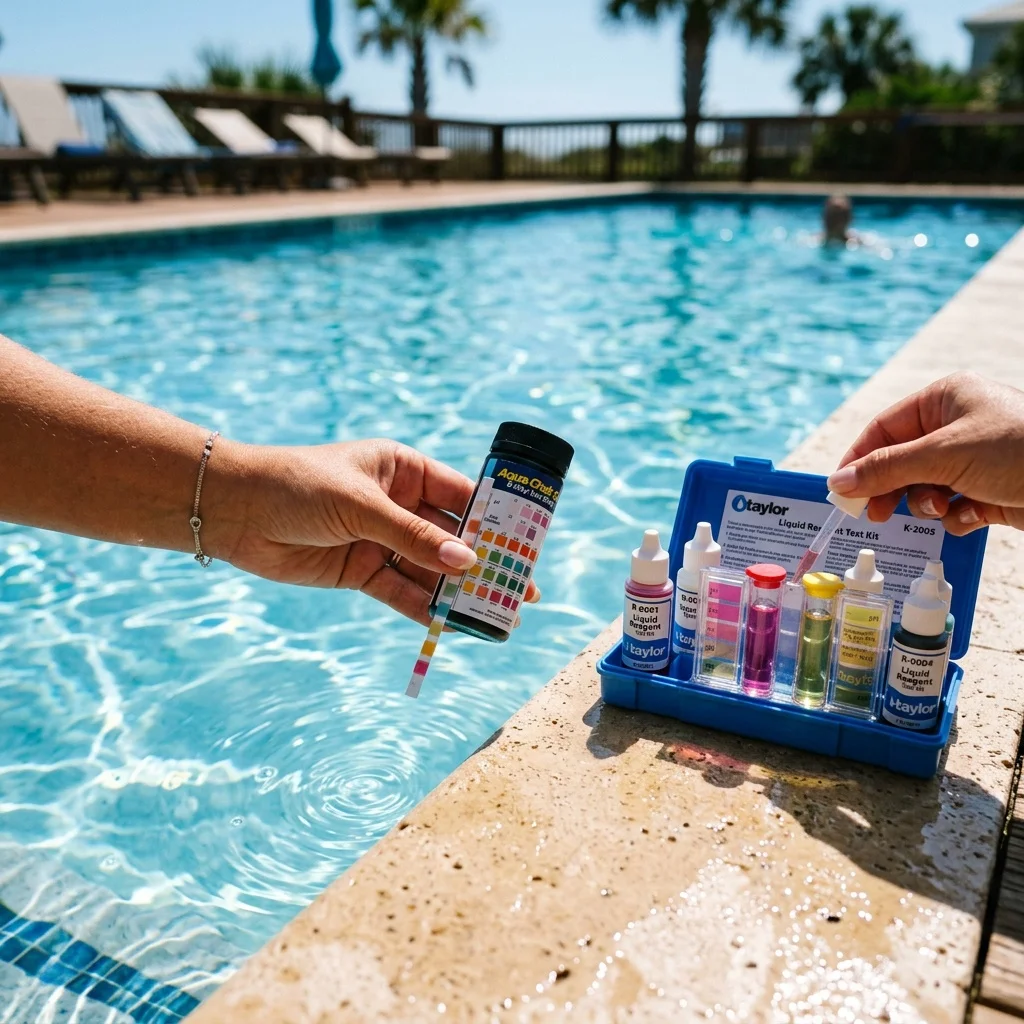
- Test chlorine, pH, alkalinity.
Hour 0 to 2 (Adjust Chemistry)
- Bring free chlorine to 5 ppm. Use liquid chlorine, not cal-hypo (which adds calcium and slightly raises pH, the opposite of what you need).
- If alkalinity dropped below 70, raise it with sodium bicarbonate to about 80 to 90.
- If pH dropped below 7.2, raise it with sodium carbonate (washing soda). Avoid raising alkalinity at the same time.
- Run the pump continuously.
Hour 4 (Brush)
- Brush walls and floor, focusing on shaded spots. Knocks loose any settled debris and lets the filter capture it.
Hour 8 to 12 (Filter Work)
- Backwash a sand or DE filter.
- If you have a cartridge filter, pull the cartridge and rinse it with a hose. Don't worry about a deep chemical clean tonight; just get the heavy debris off.
- Restart and let the pump run overnight.
Hour 24 (Reassess)
- Pool should be visibly clearer.
- Test free chlorine again. Probably still 3 to 4 ppm if the heavy lifting was right.
- Skim once more. Vacuum any settled debris on the bottom.
Hour 36 (Clarifier or Floc, If Needed)
- If the pool is still cloudy after 24 to 36 hours, the suspended particles are too fine for your filter. Add a pool clarifier (small dose). This clumps the fine particles into bigger ones the filter can grab.
- Run the pump 12 more hours.
Hour 48 (Final Check)
- Should be clear. Light still penetrates to the deepest point of the pool.
- Free chlorine 2 to 4 ppm, pH 7.4 to 7.6, alkalinity 80 to 100.
If the pool is still cloudy at hour 48, you have a different problem (filter not actually working, mustard algae developing, or phosphates running rampant). At that point, it's a service call.
Common Mistakes That Make It Worse
Shocking immediately with cal-hypo. A common reflex. The problem: cal-hypo adds calcium (already too high in many St. Johns pools) and raises pH. After the storm dropped your pH, the last thing you want is a swing back up. Use liquid chlorine.
Adding clarifier before fixing chemistry. Clarifier needs working chlorine and stable pH to do its job. If chlorine is at 0.5 and pH is at 7.0, clarifier just sits in the water making things slightly worse. Fix chemistry first.
Backwashing without testing chlorine. Backwashing removes a meaningful amount of water from the pool. If you backwash first and then add chlorine, you're chasing a moving target. Test, dose, then backwash, then top off, then re-test.
Ignoring the filter and just adding chemicals. A loaded filter can't clear cloudy water no matter how perfect your chemistry is. The filter has to be flowing properly.
Vacuuming to waste during heavy storms. If a storm is still incoming and you vacuum to waste, you'll drop water level fast, then refill from a flooded yard and pull mud into the system. Wait until the storm system clears.
Prevention: What to Do Before the Next Storm
A few quick moves that pay off:
Pre-storm chemistry buffer. If a big system is coming, raise free chlorine to 4 or 5 ppm the evening before. That cushion absorbs the dilution.
Empty the skimmers first. Going into the storm with empty baskets means more capacity for the debris load.
Check pump runtime. Set the pump to run continuously for 24 hours starting at storm onset. Stagnant water plus organic load equals fast cloudiness.
Skim before, not just after. Surface debris already there gets buried under storm debris and is harder to remove later.
Cover the spa if it's attached. The spa fills with debris during a storm worse than the pool. A cover saves you 30 minutes of post-storm scrubbing.
Watch the deck. If your deck drains toward the pool (some St. Johns lanai pools do), divert the deck runoff before the storm. That runoff carries the most concentrated phosphates and dirt.
When to Just Call Someone
A few signs that the post-storm recovery is beyond a DIY weekend:
- You're at hour 72 and the pool is still cloudy.
- You've added shock twice and chlorine still won't hold.
- You see a yellow tinge developing (mustard algae).
- The filter pressure won't come down even after backwash and cartridge cleaning.
That's a service visit. Cloudy water becomes a green pool fast in St. Johns summer.
Storm hit your pool and you don't want to chase chemistry for three days? Book a pool service in St. Johns, FL and we'll do a post-storm recovery visit: full chemistry reset, filter clean, brush and vacuum, written report on what to watch for the next 48 hours.