The Algae That Hides on Your Walls
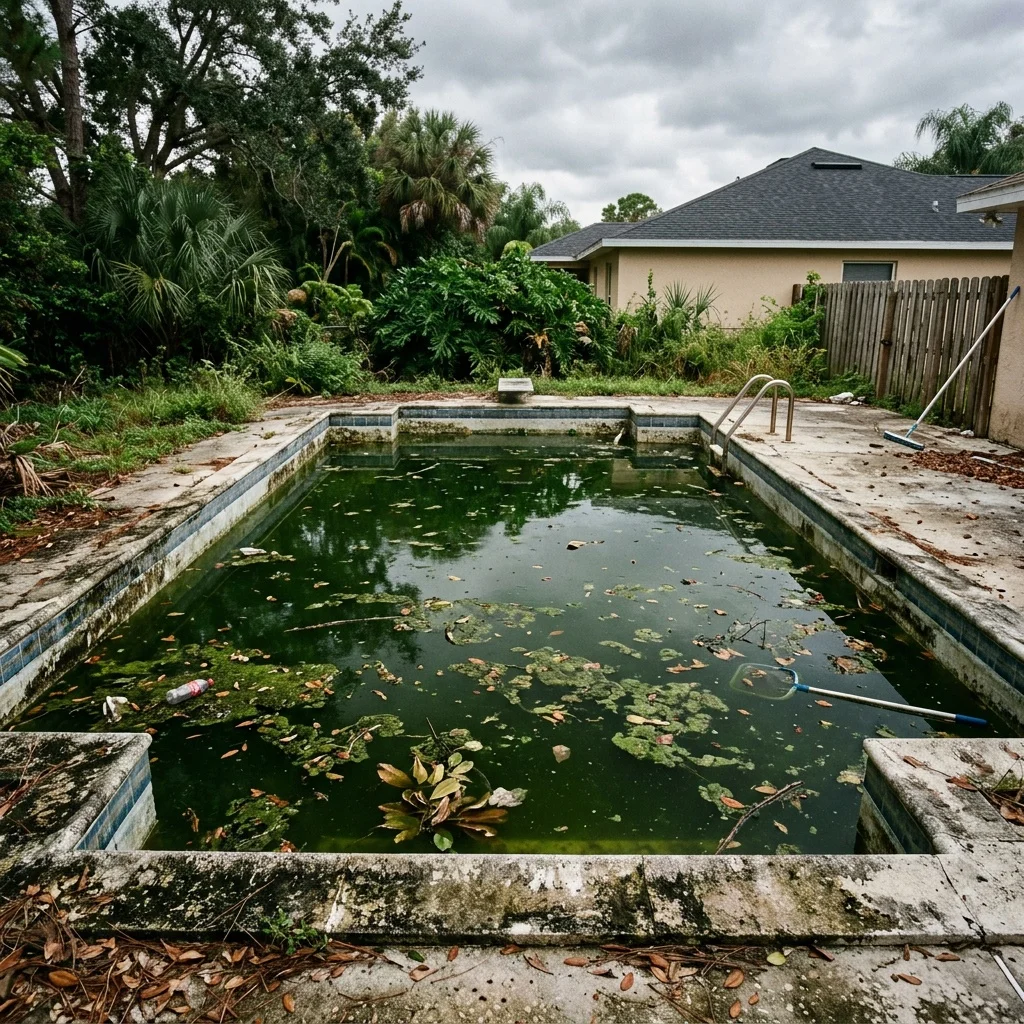
You brush your pool Saturday morning. Sunday afternoon there's a fine yellow-brown dusting along the shaded side, under the steps, around the lights. You brush it again. It comes back overnight.
That's almost certainly mustard algae. It's a different strain than the green algae everyone knows, it survives normal chlorine levels, and it's one of the most common reasons St. Johns pools "look weird" through May, June, and early July.
Here's how to confirm it's actually mustard algae (not just dirt), why it's harder to kill than green algae, and the protocol that actually keeps it gone.
Is It Mustard Algae, or Just Dust?
Three quick tests:
The brush test. Brush the suspect spot. If it disappears in a cloud and re-settles in roughly the same shape within 12 to 24 hours, it's algae. Real dust or pollen comes off, gets filtered out, and doesn't come back unless wind blows new dust in.
The location test. Mustard algae prefers shaded, low-circulation spots: the deep end shadow, behind the ladder, under the steps, the corner the return jet doesn't reach. Dust tends to be more even across the whole pool.
The chlorine test. Add a normal shock dose. Green algae dies within 24 hours of good chlorine. Mustard algae survives. If your chlorine is at 5 ppm and the yellow stuff is still there 48 hours later, it's mustard algae.
Why Mustard Algae Is Different
Mustard algae (technically a yellow-green algae from the Tribonema family) has a few traits that make it stubborn:
- It's chlorine resistant at normal levels. Free chlorine of 2 to 3 ppm doesn't kill it. You need to push to 10+ ppm to break through.
- It clings to surfaces aggressively. Brushing knocks spores loose but they re-attach within hours.
- It survives outside the pool. Spores live on swimsuits, pool toys, brushes, filters, even the deck. If you kill it in the pool but don't decontaminate the gear, it comes back from the gear.
- It cross-resists certain algaecides. Some basic poly-quat algaecides barely affect it. Copper-based or "yellow specific" algaecides work better.
- It's seasonal in St. Johns. April through July is the peak. Spores blow in on wind, especially in neighborhoods near retention ponds (most of Nocatee, RiverTown, large parts of Julington Creek).
The Kill-and-Stay-Dead Protocol
Skipping any step here is why people keep treating mustard algae and keep seeing it come back. Do all of it in order.
Day 1: Diagnose and prep
- Confirm mustard algae with the tests above.
- Test CYA. If CYA is over 80 ppm, partial-drain to bring it down to 40 to 50. Mustard algae cannot be killed effectively if CYA is sky-high because you can't get enough free chlorine into solution.
- Clean the filter thoroughly. Backwash a sand or DE filter. Cartridges get a full chemical soak (TSP solution, then rinse).
- Get pH to 7.4 to 7.6.
Day 2: Heavy shock + mustard-specific algaecide
- Shock the pool to roughly 30 ppm free chlorine. For a 20,000 gallon pool that's about 4 gallons of 12.5 percent liquid chlorine. Add at sunset with the pump running.
- After 30 minutes, add a yellow/mustard-specific algaecide per label directions. Most contain sodium bromide or quaternary ammonium. Brush aggressively, especially the shaded spots.
- Run the pump continuously for 24 hours.
Day 3: Brush, brush, brush
- Brush the entire pool 3 times during the day. Pay extra attention to corners, behind ladders, under steps, the deep end shadow.
- Check chlorine level. It should still be elevated (8+ ppm). If it dropped to normal, shock again.
Day 4: Decontaminate the gear
This is the step people skip. If you don't do this, the algae comes back from the equipment.
- Pool toys, floats, balls: 10-minute soak in a 1:10 bleach-water solution.
- Swimsuits used in the affected pool: hot wash with bleach.
- Pool brush, leaf rake, telescoping pole: same bleach soak.
- The pool steps, ladders, and any in-pool structures get scrubbed with diluted bleach using a scrub pad (with the pool already over-chlorinated, this is fine).
- The deck around the affected corners gets pressure-washed or hosed down.
Day 5: Filter again
- Clean the filter thoroughly again. The filter is now full of dead algae and spores.
- Bring chlorine back to normal (2 to 4 ppm).
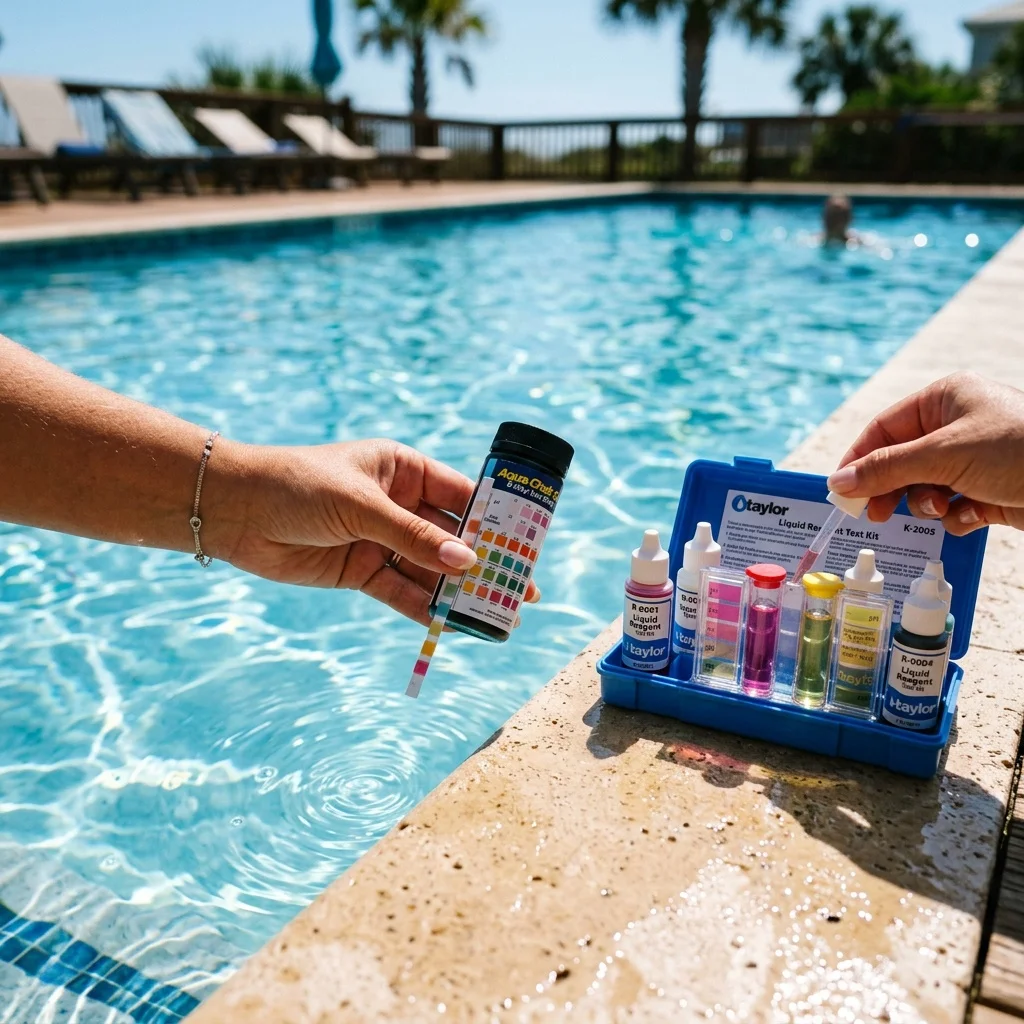
- Test CYA, pH, alkalinity.
Days 6 to 14: Watch
- Brush daily for the first week.
- Hold free chlorine at the upper end of normal (4 ppm).
- If a spot of yellow shows up, hit it with localized brushing and a small shock dose immediately.
If you finish day 14 and the pool is still clear, you've broken the cycle. Maintain normal weekly chemistry from there.
Why It Keeps Coming Back for Some Pools
Common reasons mustard algae returns:
- CYA was too high during the kill cycle and chlorine never actually got high enough to break through.
- The filter wasn't cleaned twice (before and after).
- The gear wasn't decontaminated.
- Phosphates were sky-high (over 500 ppb) and gave the algae a head start the next round.
- There's a wind-source nearby (retention pond, neighbor with neglected pool, recently disturbed yard) and you're getting re-seeded constantly.
If you've done a thorough cycle and the algae is still returning within 2 to 3 weeks, the problem is one of those five. Phosphate testing is the easiest one to rule out.
When to Call Someone
Mustard algae is one of the cases where pro help saves money. The chemical cost of a full kill cycle is $80 to $150 in product. Doing it wrong twice costs $300. Plus a pro will pull a real water panel, check CYA properly, and decontaminate methodically.
Mustard algae keeps coming back? Book green pool recovery in St. Johns, FL and we'll do a full kill cycle, decontaminate the gear, treat phosphates if needed, and put you on a weekly schedule that prevents the next round.