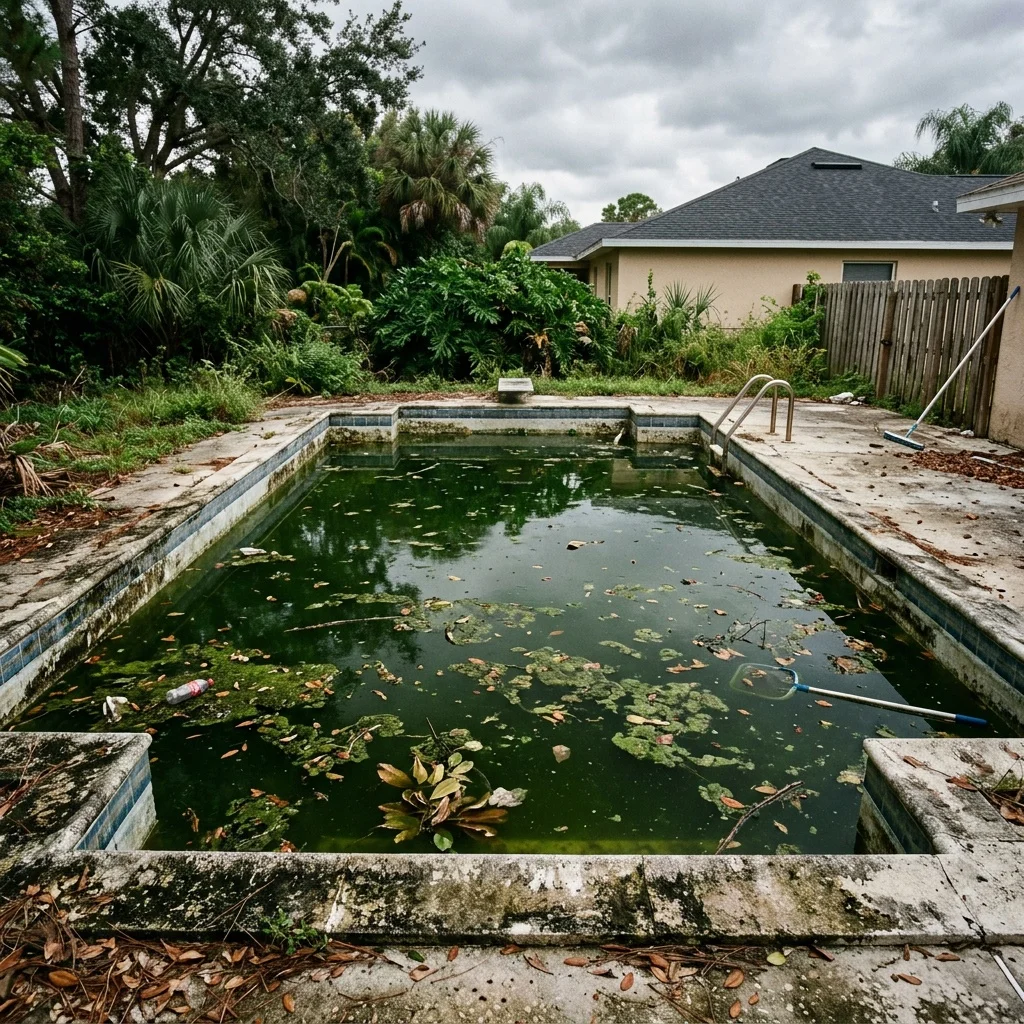
"Is My Pool Leaking?"
We get this question a lot, and the honest answer is usually no. Your pool is probably just evaporating faster than you think.
Northeast Florida has some of the highest evaporation rates in the country. Hot days, low humidity in spring, lots of sun, and a screen enclosure that traps heat but doesn't stop water from leaving. A typical residential pool in St. Johns can lose 3 to 8 inches a month to evaporation alone, depending on the season.
But sometimes it really is a leak. Here's how to tell the difference without spending money on a leak detection service before you need to.
Northeast Florida Evaporation Rates by Month
These are rough monthly water-loss ranges from evaporation alone, for an uncovered residential pool in St. Johns County:
| Month | Inches lost (typical range) |
|---|---|
| January | 1 to 2 |
| February | 1 to 2 |
| March | 2 to 4 |
| April | 3 to 5 |
| May | 4 to 6 |
| June | 5 to 7 |
| July | 5 to 8 |
| August | 5 to 7 |
| September | 4 to 6 |
| October | 3 to 5 |
| November | 2 to 3 |
| December | 1 to 2 |
A few things that shift these numbers:
- Screen enclosure: reduces evaporation by 20 to 30 percent.
- Solar cover: reduces evaporation by 50 to 70 percent (but most owners don't use them in Florida).
- High humidity weeks (typical July-September): reduces evaporation 10 to 20 percent.
- Windy April days: can spike short-term loss.
- Active swimming + splashing: adds 0.5 to 1 inch of loss per hour of heavy use.
If you're losing about 5 inches in July and you have a screen enclosure, that's well within evaporation range. If you're losing 5 inches in January, something else is going on.
The Bucket Test (The Diagnostic Every Owner Should Know)
This is the single best way to tell evaporation from leak. Takes about 24 hours and zero money.
You need:
- A 5-gallon bucket
- A way to weigh it down (a brick inside works)
- A pen or piece of tape to mark water levels
How:
- Place the bucket on the second step of your pool, inside the water. Water inside the bucket should be at the same level as the pool around it.
- Mark the water level inside the bucket and outside the bucket on the wall.
- Leave for 24 hours. Don't swim. Don't run a heater or anything that affects evaporation.
- After 24 hours, measure the drop inside the bucket and the drop in the pool.
What it means:
- Both dropped the same: evaporation. Not a leak.
- Pool dropped more than bucket: the difference is your leak rate.
Example: bucket dropped 0.4 inches, pool dropped 0.6 inches. That's a 0.2 inch leak rate, which over a month is roughly 200 to 500 gallons depending on pool surface area. Worth investigating.
If both dropped the same amount, save your wallet. You don't have a leak.
Common Leak Sources, From Most Likely to Least
When there is a real leak, here's roughly the order of usual suspects.
1. Plumbing at the equipment pad. Look at the equipment pad. Damp ground around any fitting, dripping at the pump seal, water near the filter housing. Easiest to check, often the answer.
2. Skimmer throat cracks. The plastic skimmer body cracks where it meets the deck, especially in older pools. Visual inspection finds it.
3. Pool light niche. Light fixtures have rubber seals that age. A leaking niche shows water seeping behind the light when the pool is full. Hard to see; sometimes a leak detection service is needed.
4. Return jet fittings. Plastic threaded fittings on return jets crack with age. Run a hand around each return when the pump is running and feel for water moving through.
5. Pool surface cracks. Plaster pools develop hairline cracks over the decades. Usually they're cosmetic, not leaks. But significant cracks do leak.
6. Underground main drain plumbing. The hardest leaks to find and the most expensive to fix. Requires either a pressure test, dye test, or full plumbing trace.
When to Call a Leak Detection Pro
A leak detection service typically costs $250 to $600 in St. Johns County. Worth it when:
- The bucket test confirms a real leak.
- You can't find the source after a visual inspection.
- The pool's losing more than 1 inch a day above evaporation.
- The deck around the pool is showing damp or sinking spots.
They use sonar (listens for water moving through plumbing), pressure testing (forces air through pipes and finds drops), and dye testing (checks visual seepage in light niches and skimmers).
Once they find it, the repair is separate. Common repairs:
- Plumbing repair at equipment pad: $200 to $600
- Skimmer throat re-bond: $300 to $700
- Light niche re-seal: $250 to $500
- Plumbing trench and pipe replacement: $1,500 to $5,000+
The High Water Table Caveat
A specific St. Johns warning: in parts of Nocatee, RiverTown, and lower-elevation Julington Creek, the water table is high. After a heavy rain, groundwater can show up around the pool and look like a leak. Wet spots at the pad that appear after rain and dry up in 24 hours are usually just groundwater, not pool plumbing.
If you're not sure, the bucket test still works. The bucket measures actual pool water loss, regardless of what's wet on the outside.
Habits That Catch Leaks Early
Three things that turn a small leak into an early diagnosis instead of a $3,000 repair.
1. Note your evaporation rate by month. Take 30 seconds when you top up the pool to note how often you're adding water. After a year, you'll have a baseline and any deviation will be obvious.
2. Check the equipment pad weekly. A 5-second look at the ground around the pad catches plumbing-side leaks before they get into the soil.
3. Run a bucket test once a season. Especially heading into summer (April) and heading into fall (October). Catches gradual changes.
What's Probably Happening to Your Pool
The single most common scenario: you're seeing 4 to 6 inches of loss per month in March/April, and you've assumed it's a leak because it seems like "a lot." It's not. That's normal evaporation for spring in Northeast Florida.
The second most common scenario: you have a slow plumbing leak at the equipment pad that's been there for months, but you've been topping off without noticing.
Either way, the bucket test settles it in 24 hours.
Worried about a leak and want a real assessment? Book a pool service in St. Johns, FL and we'll run the bucket test, check the equipment pad, and tell you whether you need a leak detection pro or just need to relax about evaporation.